

Omar Khayyam (1048 – 1131) was a Persian poet, mathematician, and astronomer, world-famous for the Rubáiyát a collection of quatrains that explore love, time, fate, and the meaning of life. Born in Nishapur during the Seljuk era, he also contributed to algebra, geometry, and the creation of the Jalali calendar, one of history’s most accurate solar calendars. His verses, translated into many languages, have inspired readers worldwide for centuries.
Key facts about Omar Khayyam
| Item | Detail |
| Name & variants | Omar Khayyam; Umar/Omer Khayyam; Ghiyath al‑Din Omar Khayyam; ‘Umar Khayyām (عمر خیّام) |
| Lifespan | 1048–1131 CE |
| Birthplace | Nishapur, Khorasan (northeastern Iran) |
| Fields | Mathematics, Astronomy, Philosophy, Poetry |
| Most known for | The Rubáiyát (quatrains); leadership in Jalali calendar reform; work on cubic equations; critiques of Euclid’s fifth postulate |
| Era & context | Seljuk period of the Islamic Golden Age |
| Major patrons | Nizam al‑Mulk; Seljuk court at Isfahan |
| Notable scientific works | Treatise on algebra/classification of cubics; studies on the parallel postulate; contributions to astronomical tables (zījes) |
| Poetic themes | Impermanence of life, skepticism toward dogma, carpe diem, friendship, love, wine as metaphor, limits of knowledge |
| Resting place | Tomb and modern mausoleum in Nishapur, Iran |
| How to say it | “OH‑mar ki‑YAHM” (English); ‘Umar Khayyām with long “a” in Persian |
Biography of Omar Khayyam
Early life in Nishapur (1048–1060s)
Omar Khayyam was born on May 18, 1048 CE, in Nishapur, one of the most vibrant cities in medieval Persia. His surname, Khayyam, means “tentmaker” likely a reference to his family’s craft, though in later centuries it became a poetic symbol for the temporary nature of life itself. Nishapur, in the fertile province of Khorasan, was a crossroads of the Silk Road: a place where caravans carried not just goods but also ideas from India, China, and the Arab world.
The city boasted gardens, turquoise-domed mosques, and bustling bazaars. It was also a scholarly hub, home to libraries, schools, and poets. Young Omar grew up surrounded by this mix of beauty and intellect, which would shape both his scientific curiosity and his poetic sensibility.
Studies, travels, and mentors
From an early age, Khayyam showed a talent for mathematics and astronomy. He studied under some of the best scholars of his time, mastering Euclid’s Elements, Ptolemy’s Almagest, and the works of earlier Persian and Greek philosophers. Historical accounts suggest he traveled widely to Samarkand, Balkh, Isfahan, and possibly Baghdad seeking knowledge and engaging in debates with other thinkers.
One of the most important figures in his career was Nizam al-Mulk (1018–1092), the Seljuk vizier who championed education and scientific inquiry. Nizam invited Khayyam to work at the royal observatory in Isfahan, a role that would lead to his famous reform of the Persian calendar.
The court and the Isfahan Observatory
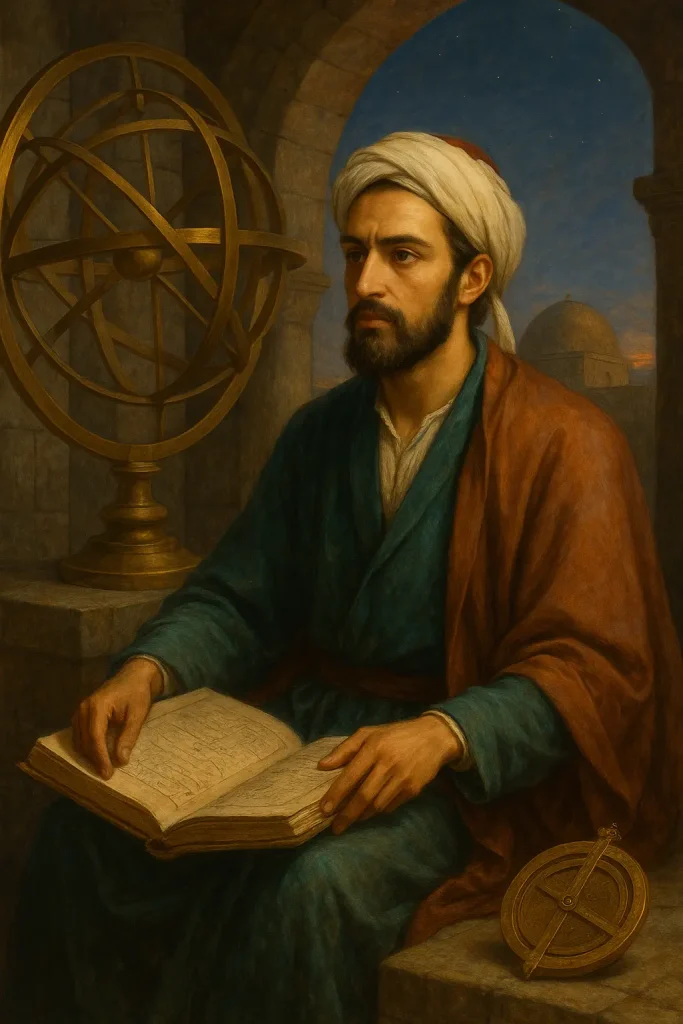
By the 1070s, Khayyam was firmly established as one of the leading intellectuals of the Seljuk Empire. At the Isfahan Observatory, he led a team of astronomers and mathematicians in precise observations of the sun, stars, and planets. This work culminated in the Jalali calendar a solar calendar of remarkable accuracy, still the basis for Iran’s modern timekeeping.
Despite his position at court, Khayyam avoided the intrigues of politics. He was known for his independence of thought, preferring the company of books and trusted friends over the corridors of power.
Later years and death in Nishapur (1131)
After the death of Nizam al-Mulk and shifts in the Seljuk court, Khayyam spent his later years in relative quiet, teaching, writing, and possibly continuing his astronomical studies. He died in 1131 CE in Nishapur. His tomb later rebuilt as a striking modern mausoleum remains a site of literary and scientific pilgrimage.
Historical context: The Seljuk Empire and the Islamic Golden Age
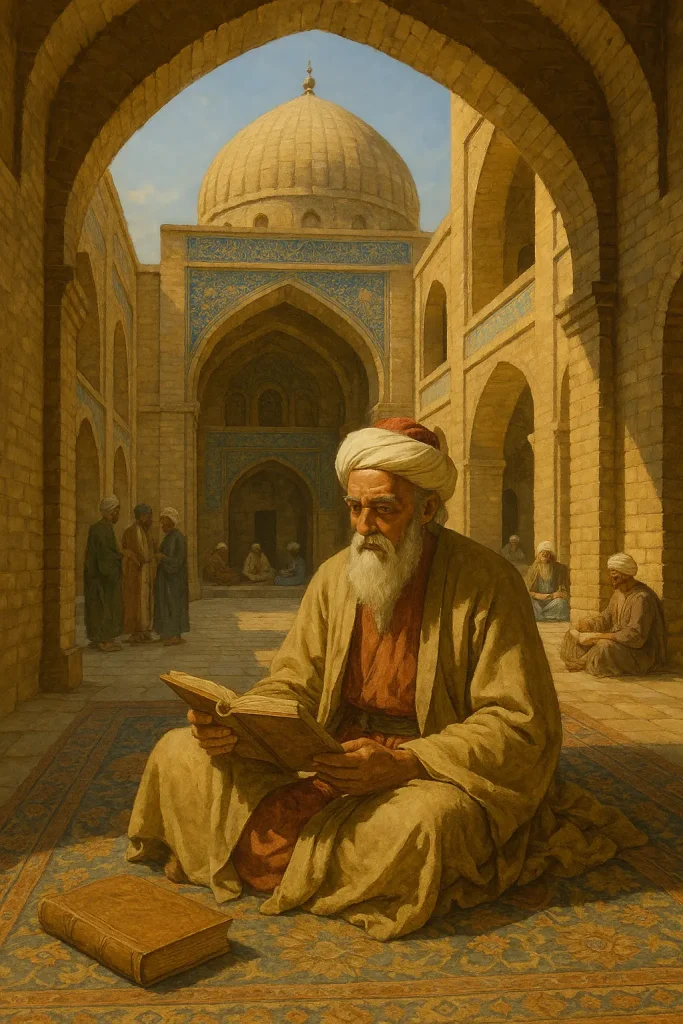
Khayyam lived during the Islamic Golden Age, a period stretching roughly from the 8th to the 14th centuries when science, philosophy, and the arts flourished across the Muslim world. The Seljuk Empire (11th–12th centuries) was one of its political and cultural high points. Spanning from Central Asia to the eastern Mediterranean, the Seljuks supported scholars through royal patronage, establishing madrasas (colleges), observatories, and libraries.
Intellectual climate
In Khayyam’s time, scholars were engaging deeply with translations of Greek, Indian, and earlier Persian works. The period saw advances in algebra, trigonometry, optics, medicine, and philosophy. Debate was a hallmark of the age: theologians like Al-Ghazali defended orthodox faith, while philosophers and scientists pushed the boundaries of rational inquiry. Khayyam’s own skepticism and mathematical rigor grew out of this intellectually charged environment.
Omar Khayyam in Mathematics
Omar Khayyam was not just a poet who dabbled in numbers he was one of the most original mathematical minds of the medieval world. His works reveal a thinker who combined Greek geometry, Islamic algebra, and his own innovations into a coherent, rigorous approach.
Classifying and solving cubic equations
In 1070 CE, Khayyam wrote his landmark Treatise on the Demonstration of Problems of Algebra. In it, he became the first mathematician to systematically classify cubic equations into different types based on their terms. Unlike earlier scholars, who often treated each case separately, Khayyam grouped them logically and sought general methods of solution.
His most famous contribution was solving these cubic equations geometrically, by intersecting a parabola with a circle. This approach built on Greek geometry but applied it in a new algebraic context. Although he didn’t find a general symbolic formula for cubics (that would come in Renaissance Italy centuries later), his classification laid the groundwork for later advances.
Table: Khayyam’s classification of cubic equations
| Type (modern form) | Khayyam’s method of solution | Notes |
| x3+ax=bx^3 + ax = bx3+ax=b | Intersection of a parabola and circle | Used conic sections as geometric tools |
| x3=ax+bx^3 = ax + bx3=ax+b | Parabola–circle intersection | Required careful geometric construction |
| x3+b=axx^3 + b = axx3+b=ax | Geometric mean approach | Mapped algebraic terms to lengths |
| Other mixed terms | Variations of conic intersections | Each case solved by custom diagram |
Euclid’s fifth postulate and early non-Euclidean thinking
Khayyam also tackled one of geometry’s oldest puzzles: Euclid’s parallel postulate. In his Explanations of the Difficulties in the Postulates of Euclid, he tried to determine whether the fifth postulate could be derived from the others. His conclusion that it was independent was a step toward what centuries later became non-Euclidean geometry.
While he didn’t break fully from Euclid’s framework, his willingness to test the foundations of geometry shows a spirit of intellectual boldness rare for the time.
Mathematical legacy and transmission to Europe
Khayyam’s algebraic and geometric writings were widely copied in the Islamic world and eventually translated into Latin. European mathematicians in the Renaissance were influenced directly or indirectly by his classifications and methods. His combination of algebra with geometry foreshadowed the analytic geometry of Descartes.
Omar Khayyam in Astronomy
In an age when astronomy was as much about calendars and governance as it was about the stars, Omar Khayyam stood at the forefront. His work combined meticulous observation with mathematical precision, producing results that would remain relevant for centuries.
The Isfahan Observatory and royal commission
In 1074 CE, Khayyam was invited by the Seljuk ruler Malik Shah I and vizier Nizam al-Mulk to join the newly established royal observatory in Isfahan. As the lead astronomer, he headed a team tasked with reforming the Persian calendar, which had drifted out of alignment with the seasons. For an agrarian society that relied on accurate timing for planting, taxation, and religious festivals, this was no small matter.
The Jalali calendar: A masterpiece of precision
After years of observation and calculation, Khayyam and his colleagues introduced the Jalali calendar in 1079 CE, named after Sultan Malik Shah’s honorific “Jalal al-Din.” It was more accurate than the Julian calendar used in Europe at the time and rivaled the Gregorian calendar introduced five centuries later.
Key features of the Jalali calendar:
- Solar-based: New Year aligned with the vernal equinox.
- Year length: 365.2424 days remarkably close to the modern value.
- Leap years: Added based on precise astronomical observation, not a fixed formula.
- Error rate: Only one day’s drift in about 5,000 years.
Table: Comparing calendars
| Feature | Jalali Calendar (1079 CE) | Julian Calendar (45 BCE) | Gregorian Calendar (1582 CE) |
| Type | Solar | Solar | Solar |
| Year length | 365.2424 days | 365.25 days | 365.2425 days |
| Leap year rule | Added as needed via observation | Every 4 years | Every 4 years, except centuries not divisible by 400 |
| Accuracy | 1 day drift in ~5,000 years | 1 day drift in ~128 years | 1 day drift in ~3,030 years |
| Purpose | Align Nowruz (Persian New Year) with exact equinox | Align civic year with solar year | Correct Julian drift for liturgical purposes |
Beyond the calendar
Khayyam’s astronomical work extended to compiling zījes astronomical tables for predicting planetary positions and refining observational instruments. While many of these works have not survived intact, references in later scholarship confirm his reputation as a careful and innovative observer.
Lasting impact
The Jalali calendar influenced the modern Iranian calendar still in use today. Its precision remains a testament to Khayyam’s mastery of both theory and observation. In bridging the gap between abstract mathematics and real world needs, he left a legacy that was as practical as it was brilliant.
The Poetry of Omar Khayyam (Rubáiyát)
Although Omar Khayyam’s mathematics and astronomy shaped the sciences of his day, it is his poetry especially his Rubáiyát that secured his place in the imagination of the world. These four line stanzas, or rubā‘ī (plural: rubā‘iyāt), distill profound reflections on life, death, love, and fate into a handful of words.
What is a rubā‘ī?
A rubā‘ī is a Persian verse form with four lines and usually an AABA rhyme scheme. The structure is deceptively simple, yet capable of carrying deep philosophical weight. In Khayyam’s hands, the form became a tool for exploring some of life’s biggest questions with elegance and brevity.
Themes in Khayyam’s poetry
Across the many quatrains attributed to him, certain themes recur:
- The fleeting nature of time life passes quickly; tomorrow is not guaranteed.
- Carpe diem savoring wine, friendship, and beauty in the present moment.
- Skepticism toward dogma questioning rigid religious or philosophical claims.
- Love and companionship human connection as one of life’s deepest pleasures.
- The mystery of existence humble acceptance that some truths remain unknowable.
Authenticity debates
Persian poetry was often transmitted orally or in handwritten anthologies, and rubā‘iyāt were easy to copy, adapt, and attribute. Manuscript collections vary widely some contain about 120 quatrains credited to Khayyam, others more than 1,000. Scholars generally agree that many of these are by later poets imitating his style.
The most likely authentic quatrains share certain traits: philosophical skepticism, concise imagery, and a distinctive mix of melancholy and joy. This ambiguity over authorship has only added to the mystique of the Rubáiyát.
Edward FitzGerald’s translation
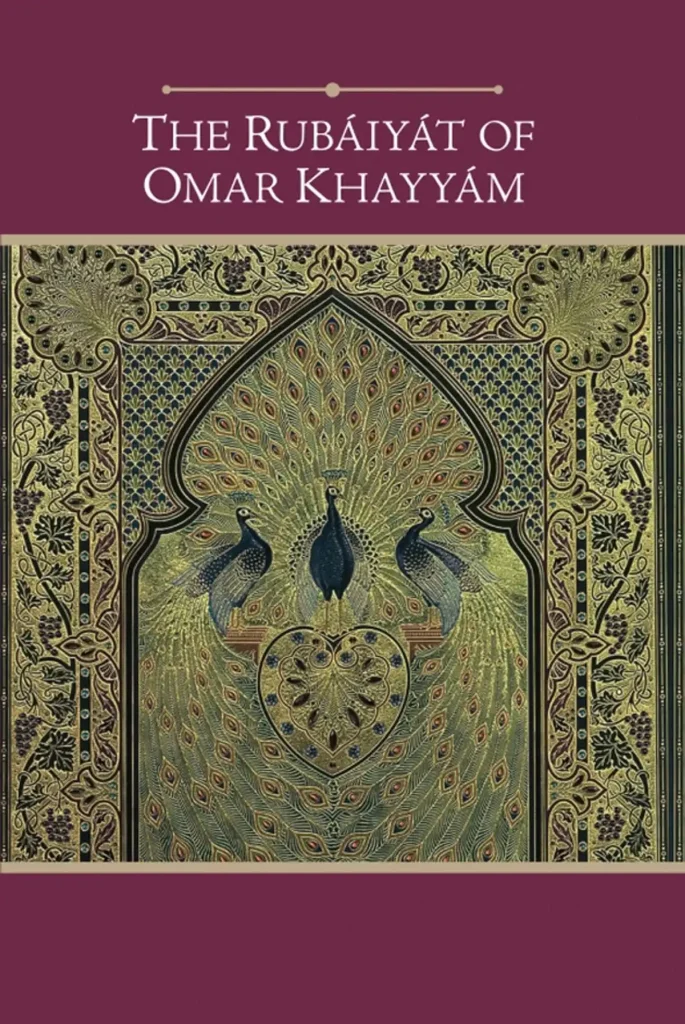
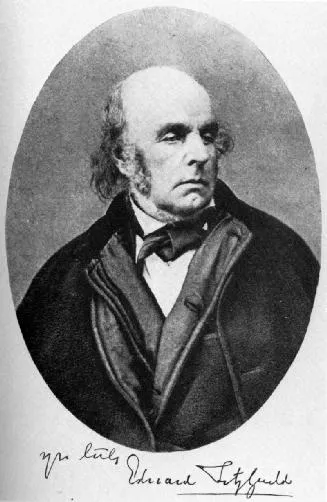
In 1859, the English poet Edward FitzGerald published his loose, imaginative translation of the Rubáiyát of Omar Khayyám. It was not a literal rendering; FitzGerald blended, rearranged, and reinterpreted quatrains to suit Victorian sensibilities. Yet his version became a literary sensation, introducing Khayyam to Europe and America and inspiring artists, musicians, and philosophers.
FitzGerald’s translation emphasized sensual imagery and a bittersweet acceptance of life’s impermanence. While scholars debate its accuracy, its cultural impact is undeniable.
Famous quatrains
Omar Khayyam’s rubā‘iyāt have captivated readers for centuries, weaving together philosophy, wit, and a deep awareness of life’s impermanence. Below is a selection of his most celebrated verses, presented in the original Persian alongside Edward FitzGerald’s classic English renderings.
اسرار اَزَل را نه تو دانی و نه من
وین حرفِ معمّا نه تو خوانی و نه من
هست از پس پرده گفتوگوی من و تو
چون پرده برافتد، نه تو مانی و نه من
“There was the Door to which I found no Key
There was the Veil through which I might not see
Some little talk awhile of Me and Thee
There was—and then no more of Thee and Me”
آنان که محیط فضل و آداب شدند
در جمع کمال شمع اصحاب شدند
ره زین شب تاریک نبردند برون
گفتند فسانهای و در خواب شدند
“The Revelations of Devout and Learn’d
Who rose before us, and as Prophets burn’d
Are all but Stories, which, awoke from Sleep
They told their comrades, and to Sleep return’d”
یاران موافق همه از دست شدند
در پای اجل یکان یکان پست شدند
خوردیم ز یک شراب در مجلس عمر
دوری دو سه پیشتر ز ما مست شدند
“For some we loved, the loveliest and the best
That from his Vintage rolling Time hath prest
Have drunk their Cup a Round or two before
And one by one crept silently to rest”
گر بر فلکم دست بدی چون یزدان
برداشتمی من این فلک را ز میان
از نو فلکی دگر چنان ساختمی
کازاده بکام دل رسیدی آسان
“Ah, Love! could you and I with Him conspire
To grasp this sorry Scheme of Things entire
Would not we shatter it to bits—and then
Re-mould it nearer to the Heart’s Desire”
یکچند به کودکی به استاد شدیم
یکچند ز استادی خود شاد شدیم
پایان سخن شنو که مارا چه رسید
چو آب برآمدیم و چون باد شدیم!
“With them the seed of Wisdom did I sow
And with mine own hand wrought to make it grow
And this was all the Harvest that I reap’d
I came like Water, and like Wind I go”
Influence on Persian and world literature
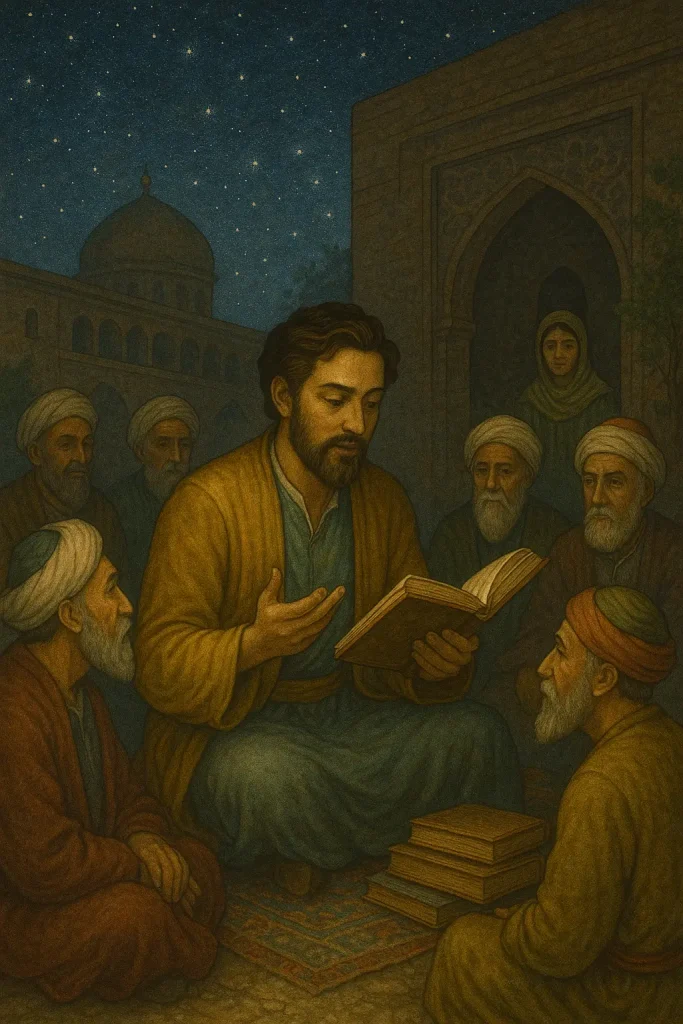
In the Persian-speaking world, Khayyam’s quatrains are woven into everyday life, recited at gatherings and quoted in conversation. In the West, his Rubáiyát helped spark a fascination with Persian poetry, paving the way for translations of Hafez, Saadi, and Rumi.
Omar Khayyam’s Philosophy
Beneath the beauty of Omar Khayyam’s quatrains and the precision of his scientific work lies a distinct worldview one that blends skepticism, rational inquiry, and a deep appreciation for life’s fleeting joys. His philosophy resists easy categorization: he has been called a skeptic, a humanist, a Sufi, and even an existentialist ahead of his time.
Skepticism and the limits of certainty
Khayyam questioned whether human beings could ever truly grasp ultimate truths about the universe, the afterlife, or divine will. While he valued reason and observation, he doubted the possibility of complete certainty whether claimed by religious authorities or philosophers.
This skepticism emerges often in his poetry: learned men debate endlessly, but “evermore / Came out by the same door as in I went.” For Khayyam, admitting the limits of knowledge was not defeat, but a step toward intellectual honesty.
Rational inquiry over blind faith
Khayyam’s scientific work shows a clear preference for evidence over tradition. In mathematics and astronomy, he followed where calculations and observations led, even if that meant challenging centuries old assumptions (as with Euclid’s fifth postulate). This rationalist streak carried over into his reflections on human existence.
Humanism and the pursuit of joy
Despite his doubts, Khayyam was not a pessimist. Instead, he urged people to embrace the tangible joys of life friendship, love, music, wine without being paralyzed by fear of death or the unknown. These pleasures were not frivolous to him; they were an antidote to life’s brevity and uncertainty.
Drink! for you know not whence you came, nor why:
Drink! for you know not why you go, nor where.
Secular or mystical?
Scholars still debate whether Khayyam’s references to wine and earthly pleasure should be read literally or metaphorically in a Sufi sense, as symbols of spiritual ecstasy. The truth may be that he moved between both registers capable of religious wonder but unwilling to accept any truth untested by reason.
A timeless resonance
Modern readers often see Khayyam as a kindred spirit: someone who can acknowledge the vast unknown, question authority, and still celebrate life. This balance of doubt and joy is perhaps why his words remain fresh nearly a thousand years later.
Khayyam Through Others’ Eyes
Omar Khayyam’s legacy, spanning mathematics, astronomy, and poetry, has sparked diverse interpretations among scholars, writers, and thinkers across centuries, each viewing him through the lens of their own era and expertise. These perspectives reveal not only Khayyam’s multifaceted genius but also the debates over his true character rationalist, mystic, or something in between.
Edward FitzGerald, the Victorian poet-translator, reshaped Khayyam’s Rubáiyát into a melancholic meditation on fate and transience, emphasizing sensual imagery to captivate Western audiences. His 1859 translation, though criticized for its liberties, framed Khayyam as a hedonistic skeptic, with lines like “A Book of Verses underneath the Bough” evoking a romantic carpe diem ethos (FitzGerald, 1859). In contrast, George Sarton, a historian of science, celebrated Khayyam as a mathematical pioneer whose geometric solutions to cubic equations bridged Greek and Islamic traditions, noting that his Treatise on Algebra “laid a foundation for later algebraic progress” (Sarton, 1927). Sarton saw Khayyam’s scientific rigor as his primary legacy, with poetry as a secondary, though brilliant, pursuit.
Bertrand Russell, the philosopher, admired Khayyam’s rational skepticism, viewing his poetry as a proto-existentialist challenge to dogmatic certainty, particularly in its questioning of divine purpose (Russell, 1945). Meanwhile, Arthur J. Arberry, an Orientalist scholar, argued for a mystical reading, suggesting Khayyam’s wine imagery reflected Sufi allegories of divine intoxication, though he cautioned that “his mysticism is tempered by rational doubt” (Arberry, 1952). This tension between mysticism and skepticism also intrigued Sadegh Hedayat, the modernist Iranian writer, who portrayed Khayyam as a defiant humanist whose quatrains rejected religious orthodoxy in favor of life’s fleeting joys (Hedayat, 1934).
Ali Dashti, an Iranian essayist, offered a more critical view, asserting that many rubā‘iyāt attributed to Khayyam were later imitations, but he praised the authentic core for its “lucid, unsparing confrontation with mortality” (Dashti, 1971). Finally, Peter Avery, a translator and Persianist, emphasized Khayyam’s cultural synthesis, blending Persian poetic tradition with universal philosophical questions, making him a timeless figure who “speaks to both heart and mind” (Avery, 2007). These varied lenses poet, scientist, skeptic, mystic underscore the challenge of pinning Khayyam down, as each thinker finds in him a reflection of their own intellectual priorities.
This diversity of views sets the stage for understanding Khayyam’s broader cultural and intellectual impact, which continues to resonate across disciplines and borders
Legacy and Cultural Impact of Omar Khayyam
Nearly nine centuries after his death, Omar Khayyam’s name still resonates in both scholarly and popular culture. His influence bridges continents, disciplines, and languages a rare feat for any historical figure.
Scientific legacy
In mathematics, Khayyam’s classification of cubic equations and geometric solutions was a milestone in algebra’s development. His critique of Euclid’s fifth postulate prefigured the birth of non Euclidean geometry centuries later. In astronomy, the Jalali calendar remains one of the most accurate solar calendars ever devised and directly shaped the modern Iranian calendar.
His methods combining logical reasoning with empirical observation became models for later scientists. In both the Islamic world and Renaissance Europe, Khayyam’s name was associated with rigor, innovation, and intellectual courage.
Literary and philosophical impact
In the Persian speaking world, Khayyam’s Rubáiyát are part of everyday language. They are recited at Nowruz gatherings, quoted in conversation, and taught in schools. His blend of skepticism and humanism has made him a touchstone for modern Iranian intellectuals navigating the space between tradition and modernity.
In the West, Edward FitzGerald’s 19th-century translation turned the Rubáiyát into a publishing sensation. Poets, novelists, and thinkers from T. S. Eliot to Jorge Luis Borges have cited Khayyam as an influence. His verses inspired generations of artists, often interpreted through the lens of Romanticism and Victorian melancholy.
In art, music, and film
- Visual art: Illustrators like Edmund Dulac, Willy Pogany, and René Bull created lavish editions of the Rubáiyát, fusing Persian motifs with Art Nouveau elegance.
- Music: Composers such as Granville Bantock and Alan Hovhaness set his verses to orchestral or choral arrangements, blending Eastern and Western musical traditions.
- Cinema: From Hollywood adaptations to Iranian art films, Khayyam’s quatrains have been used to frame themes of destiny, love, and existential doubt.
Popular culture
Even beyond literature and the arts, Khayyam’s words have appeared on posters, in advertising campaigns, and in speeches. Phrases like “The Moving Finger writes…” have entered the English language as proverbial wisdom.
Films About Omar Khayyam
Omar Khayyam’s life and poetry have inspired filmmakers across the globe, from Hollywood epics to independent art-house productions. These films portray him not only as a celebrated Persian poet but also as an astronomer, mathematician, and philosopher whose ideas transcend centuries.
Omar Khayyam (1957)
Directed by William Dieterle and starring Cornel Wilde, Michael Rennie, and Debra Paget, this mid-century Technicolor production dramatizes Khayyam’s work on the Persian calendar, his friendships and rivalries, and a romantic subplot woven into the political intrigue of the Seljuk court.
Omar Khayam (1923)
A rare silent American film featuring Ramón Novarro. Loosely inspired by the Rubáiyát, it blends stylized Persian settings with dreamlike, poetic imagery, reflecting the mysticism in Khayyam’s verses.
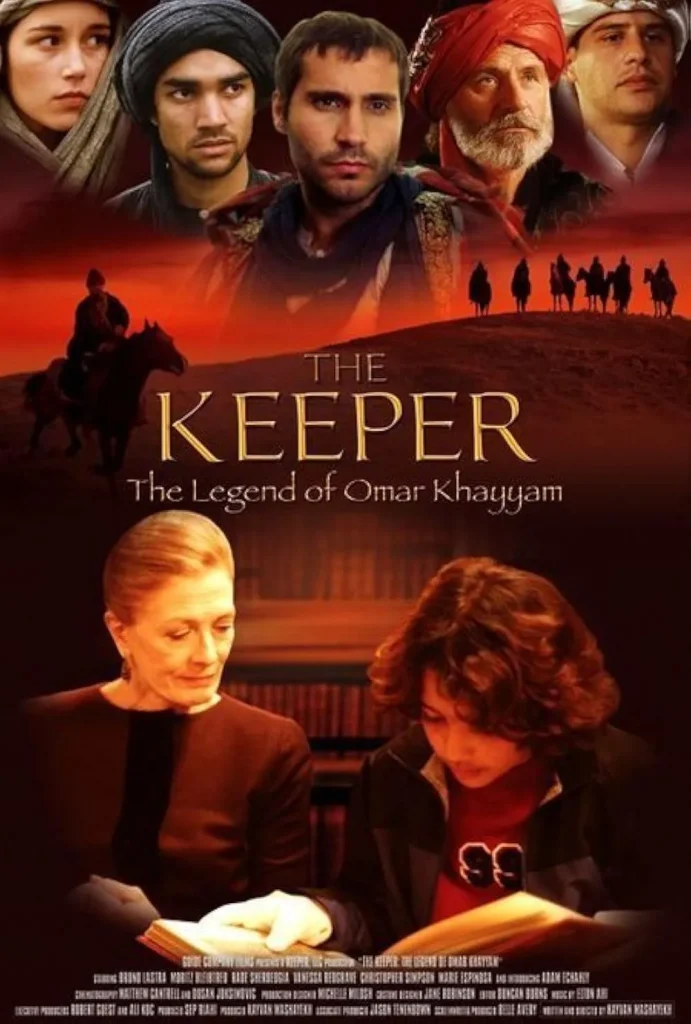
The Keeper: The Legend of Omar Khayyam (2005)
Written and directed by Kayvan Mashayekh, with Vanessa Redgrave and Moritz Bleibtreu in supporting roles, this modern drama interweaves the story of a 21st-century boy discovering his ancestral link to Khayyam with lavishly filmed historical flashbacks set in Samarkand and Bukhara.
Omar Khaiyyam (1946)
Directed by Mohan Sinha and starring K. L. Saigal, this Hindi-language production celebrates Khayyam’s poetry and philosophical reflections, framing them within a dramatic love story and rich period sets.
Why he matters today
Omar Khayyam’s enduring relevance lies in his ability to unite reason and wonder. In a world still divided by dogma, his voice reminds us to question boldly, to measure carefully, and to live fully. Whether contemplating the stars or sharing wine with friends, his message is both timeless and deeply human.
The Tomb of Omar Khayyam (Nishapur)
Omar Khayyam’s final resting place is more than a gravesite it’s a symbol of Persian cultural pride and a pilgrimage point for lovers of poetry, science, and history.
History of the gravesite
Khayyam died in 1131 CE in his hometown of Nishapur, in the province of Khorasan (northeastern Iran). For centuries, his grave was simple and largely known only to locals and scholars. As his fame grew especially after the global success of FitzGerald’s Rubáiyát in the 19th century interest in honoring his memory increased. Iranian intellectuals and cultural leaders began calling for a memorial that reflected both his scientific genius and poetic spirit.
The modern mausoleum by Hooshang Seyhoun
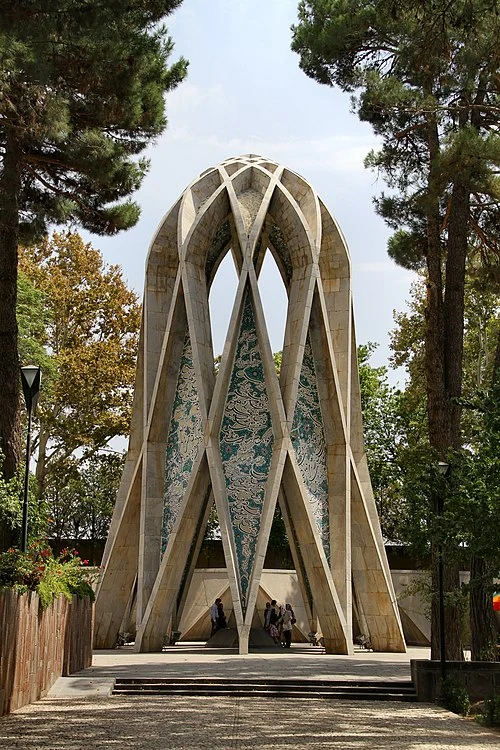
In 1963, architect Hooshang Seyhoun designed a striking modern mausoleum for Khayyam. Rising almost 22 meters (72 feet), the structure blends modernist geometry with traditional Persian motifs. Its twelve interlacing pointed arches recall both the patterns of Islamic architecture and the precision of mathematical design.
Symbolism in the design:
- Geometric latticework: Represents Khayyam’s contributions to mathematics and astronomy.
- Openwork design: Allows sunlight to filter through, symbolizing enlightenment and the interplay of shadow and light in human understanding.
- Inscriptions: Marble panels bear some of Khayyam’s most famous quatrains in Persian calligraphy.
- Garden setting: In line with Persian tradition, the mausoleum is surrounded by cypress trees, flowerbeds, and reflective pools.
Visiting the tomb today
Khayyam’s tomb is a highlight of cultural tourism in Iran. Each year on May 18th (his birthday), poets, mathematicians, and admirers gather for readings, lectures, and celebrations. Visitors often scatter rose petals around the site, echoing Khayyam’s own verse foretelling his grave would be in a place where the north wind scatters roses. For many travelers, the experience is enriched by the warmth of local people Iranians are widely regarded as remarkably friendly to tourists, adding an extra layer of hospitality to the cultural significance of the visit.
The site is typically included on tours of northeastern Iran, alongside the tombs of other cultural giants like Ferdowsi and Attar of Nishapur.
Frequently Asked Questions about Omar Khayyam
Who was Omar Khayyam?
Omar Khayyam (1048–1131 CE) was a Persian polymath mathematician, astronomer, philosopher, and poet best known for his Rubáiyát (quatrains) and his role in creating the precise Jalali calendar.
What is Omar Khayyam most famous for?
Internationally, he’s most famous for his poetry, especially through Edward FitzGerald’s 19th-century English translation of the Rubáiyát. In the scholarly world, he’s equally respected for his mathematical classification of cubic equations and his astronomical work.
How accurate is the Jalali calendar?
Very accurate: it has a drift of only one day in about 5,000 years, making it more precise than the Julian calendar and comparable to the Gregorian calendar used today.
Did Omar Khayyam really write all the Rubáiyát?
Not all of them. Some quatrains attributed to him are likely the work of later poets. Manuscript evidence suggests a core of authentic verses, unified by philosophical skepticism, elegant brevity, and existential themes.
Was Omar Khayyam a Sufi or a skeptic?
Interpretations vary. Some read his verses as mystical allegory; others see them as expressions of rational skepticism. He may have navigated both worlds, combining spiritual curiosity with intellectual independence.
What is Omar Khayyam’s most famous poem?
One of the most iconic quatrains is known as the “Moving Finger” stanza in FitzGerald’s translation:
The Moving Finger writes; and, having writ,
Moves on: nor all your Piety nor Wit
Shall lure it back to cancel half a Line,
Nor all your Tears wash out a Word of it.
Where is Omar Khayyam buried?
In Nishapur, Iran, in a modern mausoleum designed by architect Hooshang Seyhoun. The tomb is surrounded by gardens and engraved with his verses.
Sources
- Aminrazavi, Mehdi. Omar Khayyam: A Philosopher, Scientist, and Poet. Iranian Studies, vol. 39, no. 4, 2006.
- Hogendijk, Jan P. “Omar Khayyam’s Algebra.” Historia Mathematica, vol. 16, no. 1, 1989.
- Teimourian, Hazhir. Omar Khayyam: Poet, Rebel, Astronomer. The History Press, 2007.
- Stanford Encyclopedia of Philosophy – “Omar Khayyam.”
- Encyclopaedia Iranica – “Omar Khayyam.”
- https://www.imdb.com/
- FitzGerald, Edward. The Rubáiyát of Omar Khayyám (various editions).


