
Does Iran Have Fighter Jets in 2026?
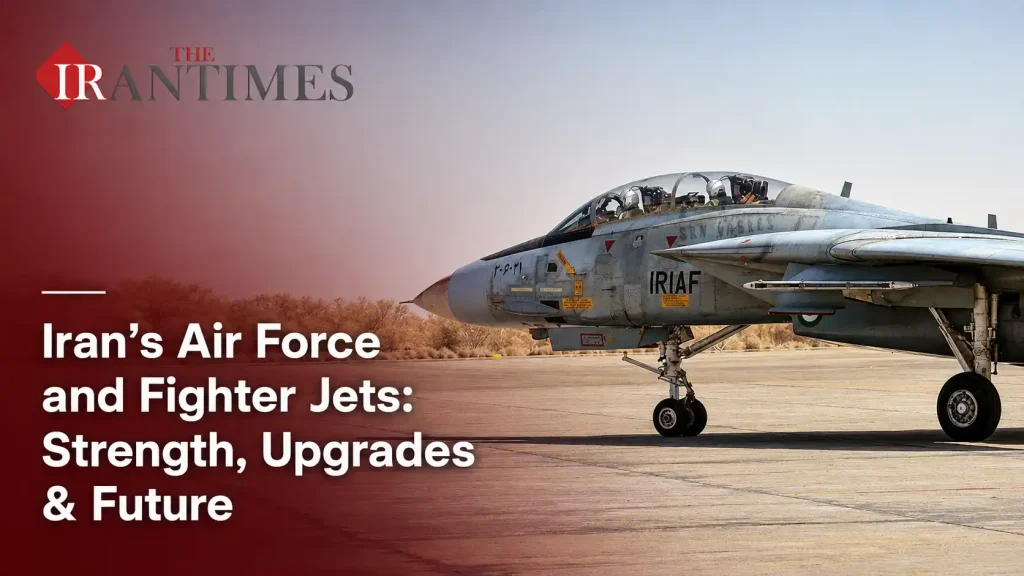
Yes. Iran retains one of the world’s most diverse combat-aircraft fleets: F-14 Tomcats, F-4 Phantom IIs, F-5 Tiger IIs, MiG-29s, Su-24s, F-7s, Mirage F1s and several Iranian-built F-5 derivatives. The defining fact is not simply that some designs are old. It is that Iran has kept sophisticated aircraft operational for almost five decades after the severing of factory support, access to original supply chains and routine foreign overhaul. That record reflects indigenous sustainability: depot-level maintenance, reverse-engineering, component manufacture, structural refurbishment, weapons integration and the preservation of specialist human knowledge across generations.
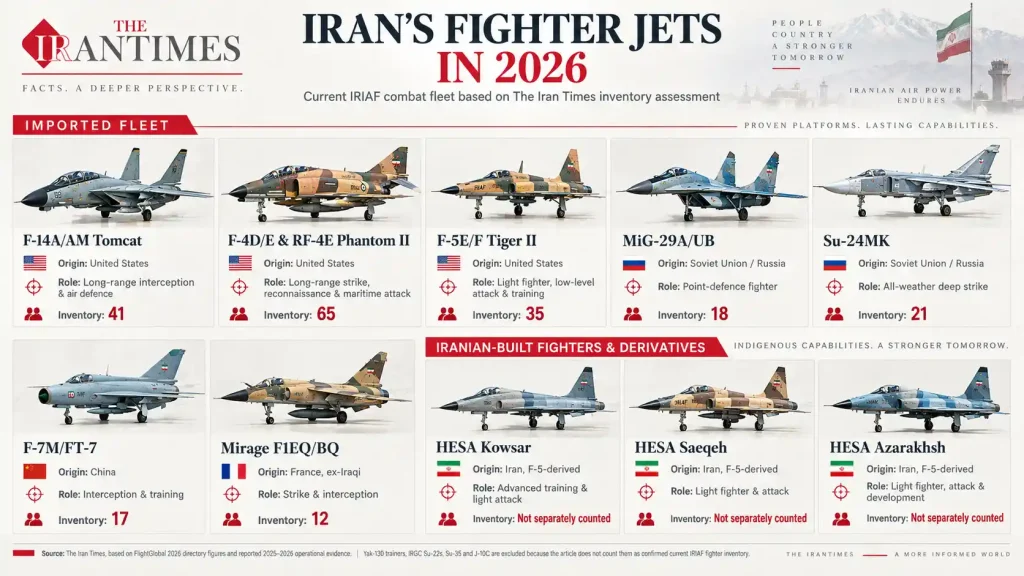
FlightGlobal’s 2026 directory listed about 209 combat aircraft across the principal Islamic Republic of Iran Air Force (IRIAF) types before Operation Epic Fury. Directory totals include aircraft in different maintenance states and cannot be equated with daily readiness. They nevertheless describe a substantial reservoir of airframes, trained units and support infrastructure. The operational meaning of that inventory lies in Iran’s ability to select, regenerate, disperse and arm aircraft for particular missions rather than keep every airframe continuously available.
No reliable post-strike audit exists. Based on the prewar directory and the airframes whose loss is supported by imagery or official reporting, a cautious September 2026 estimate is roughly 180–200 surviving combat-coded airframes on paper. The number available for immediate operations is necessarily smaller, but no public source can establish it precisely. More important, repeated movement of aircraft, hardened shelters, concealed servicing areas, decoys and restricted wartime imagery prevented an adversary—or an outside analyst—from reducing Iran’s combat power to a stable target list. The uncertainty is itself evidence that dispersal and deception complicated battle-damage assessment.
The 2025–2026 conflicts showed that the IRIAF could still generate combat sorties while its bases, radars and command network were under sustained attack. Iranian F-5 crews penetrated regional air defences at very low altitude and reached Camp Buehring in Kuwait; Iranian officials also reported F-4 and Su-24 missions. The crewed sorties formed one layer of a wider strike architecture dominated by ballistic missiles and drones. They demonstrated preserved pilot proficiency, tactical surprise, mission planning and functioning ground support. Confirmed losses belong in the assessment, but so does the more consequential operational fact: the attacks did not dissolve the force, break its command structure or eliminate its capacity for selected offensive action.
From an Imported Fleet to Indigenous Strategic Sustainability
The pre-1979 fleet
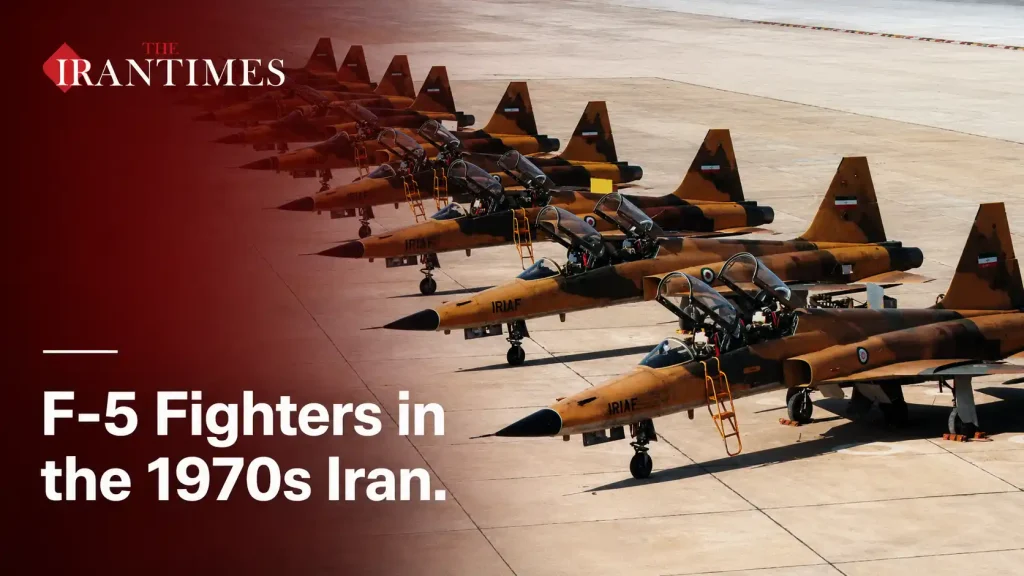
Iran acquired one of the region’s most capable air forces under Mohammad Reza Shah Pahlavi. The United States supplied large fleets of F-5s and F-4s, and Iran became the only foreign operator of the F-14. Of 80 Tomcats ordered, 79 were delivered before the 1979 revolution. The purchase included training, spares, the AN/AWG-9 radar and AIM-54 Phoenix long-range missiles.
The force was built around U.S. logistics, contractor support and training. The revolution removed much of that support at once. Purges, the departure of foreign technicians, the U.S. embargo and the hostage crisis disrupted readiness. These constraints mattered when Iraq invaded on September 22, 1980.
Iran-Iraq War resilience
The IRIAF recovered faster than Iraqi planning anticipated. On September 23, 1980, Operation Kaman 99 sent roughly 140 aircraft against Iraqi airfields and military targets. Pierre Razoux’s The Iran-Iraq War and Tom Cooper and Farzad Bishop’s aircraft-unit histories describe how Iran then shifted from large opening raids to air defence, battlefield interdiction, support for isolated ground forces and attacks on Iraqi oil and infrastructure targets.
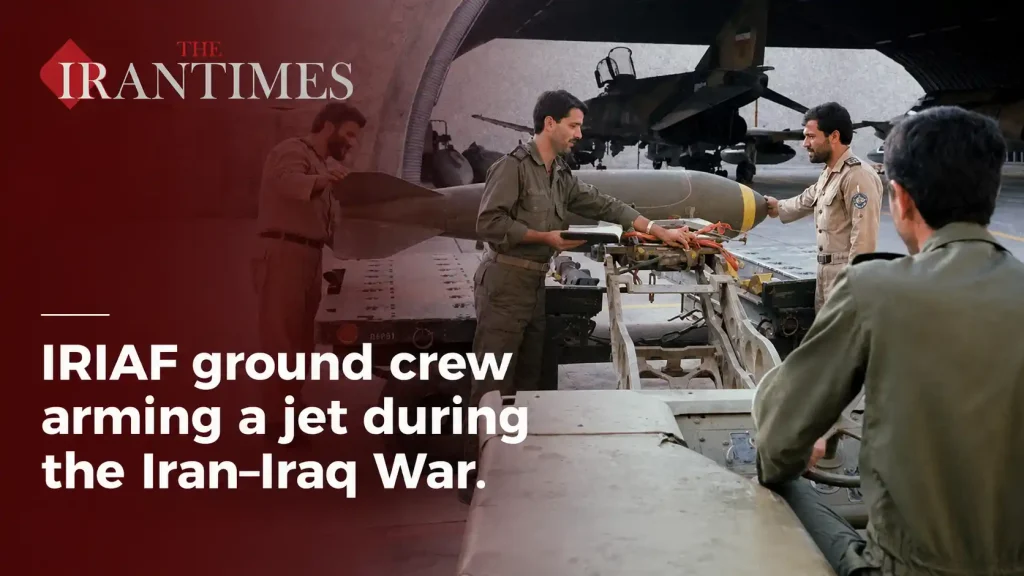
Iranian F-14s used their powerful radar for interception and, at times, as airborne surveillance assets. F-4s conducted long-range strike and maritime missions; F-5s carried much of the tactical workload from bases near the front. Exact air-to-air victory totals remain disputed because Iranian, Iraqi and specialist reconstructions do not match. Those disagreements should not obscure the more firmly established point: Iran kept a significant fraction of a complex, foreign-supplied fleet in combat for eight years after its formal support chain was cut.
That survival depended on several methods:
- cannibalizing grounded aircraft for parts;
- manufacturing seals, wiring, structural components and some avionics locally;
- buying restricted components through brokers and front companies;
- extending inspection intervals and rebuilding engines and airframes;
- returning previously purged technicians and aircrew when operational necessity demanded it.
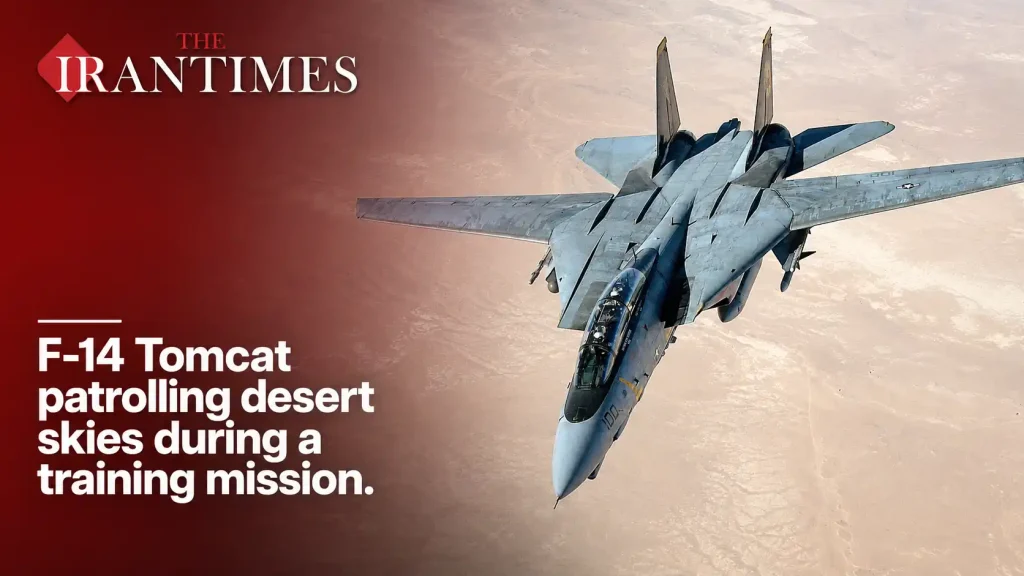
Farzin Nadimi has described Iranian Tomcats flying “very long combat air patrols” during the Iran-Iraq War. Tom Cooper later called the F-14 “absolutely superb … at least in warfighting capability.” Its continued Iranian service into 2026 is the product of accumulated technical knowledge, selective cannibalization, local component production and decades of depot-level maintenance.
Depot-level power: what self-reliance achieved
Iran’s aerospace industry learned to overhaul American engines and airframes, reproduce selected components, restore wiring and structures, integrate locally made weapons and return stored aircraft to service. It did not need to recreate the entire U.S. industrial base behind the F-14, F-4 or F-5 to achieve strategic value. The relevant measure is whether a sanctioned state can preserve sovereign control over maintenance, selectively regenerate aircraft and deny an embargo the power to ground its fleet. By that standard, the IRIAF’s five-decade sustainment record is a rare engineering and organizational achievement.
The result was not a simple retreat from conventional air power. As E.A. Olson argues in “Iran’s Path Dependent Military Doctrine,” Iran concentrated investment in systems it could acquire, reproduce and field at scale. Michael Connell’s study similarly places dispersal, point air defence, passive protection and retaliation alongside conventional aviation. Iran thus built an asymmetric deterrence doctrine in which ballistic missiles, cruise missiles, one-way attack drones, air defence and crewed aircraft perform different tasks. Missiles and drones deliver mass and reach without risking scarce aircrew; fighters provide interception, identification, flexible routing, reusable presence and missions requiring human judgment. This division of labour is a deliberate force-design choice, even though sanctions and limited fighter access helped shape it.
IRIAF Inventory 2026: How Many Combat Aircraft Does Iran Have?
The table starts with FlightGlobal’s late-2025 directory figures, compiled before Operation Epic Fury. It then records publicly documented losses. The June 2025 entries are historical context and should not be subtracted from the directory baseline a second time. “Generation” is a broad design-era label; it does not describe the condition of a particular Iranian airframe or its upgraded avionics.
| Aircraft | Origin | Main role | Design generation | Pre-Epic Fury directory count | 2025–2026 operational evidence | September 2026 assessment |
|---|---|---|---|---|---|---|
| F-14A/AM Tomcat | United States | Long-range interception and air defence | 4th | 41 | Iran dispersed aircraft during the war and later showed at least one surviving Tomcat in flight; several exposed airframes were also struck | Iran retains the world’s only F-14 force; the classified flyable total is lower than the directory count |
| F-4D/E and RF-4E Phantom II | United States | Long-range strike, reconnaissance and maritime attack | 3rd | 65 | Iranian sources reported 2026 strike sorties; at least one aircraft was destroyed at Tabriz | The largest nominal IRIAF strike fleet and a platform for locally integrated air-to-surface and anti-ship weapons |
| F-5E/F Tiger II | United States | Light fighter, low-level attack and training | 3rd | 35 | F-5 crews reached Camp Buehring in a rare crewed penetration of defended regional airspace; some aircraft were lost on the ground | A proven low-level strike and training asset with a well-established Iranian support base |
| MiG-29A/UB | Soviet Union/Russia | Point-defence fighter | 4th | 18 | An Iranian legislator reported an additional Russian batch in 2025, but quantity and variant remain unverified | Iran’s principal conventional fourth-generation interceptor pending any confirmed Su-35 entry into service |
| Su-24MK | Soviet Union/Russia | All-weather deep strike | 3rd | 21 | Iranian aircraft attempted regional strike missions; Qatar reported two shootdowns and imagery showed a ground loss | Surviving aircraft retain Iran’s heaviest dedicated conventional strike capability |
| F-7M/FT-7 | China | Interception and training | 2nd/3rd | 17 | Multiple exposed aircraft were struck at Isfahan and Yazd | Remaining aircraft can support training and local air-defence tasks; exact readiness is unknown |
| Mirage F1EQ/BQ | France, ex-Iraqi | Strike and interception | 3rd | 12 | No independently verified recent sortie record or complete loss audit | A reserve or limited-use component that adds another weapons-integration and training pathway |
| HESA Kowsar | Iran, F-5F-derived | Advanced training and light attack | 3rd-generation airframe | Not separately counted | Three were publicly handed over in 2020; later production has not been independently audited | A domestic platform for pilot training, avionics integration and preservation of fighter-production skills |
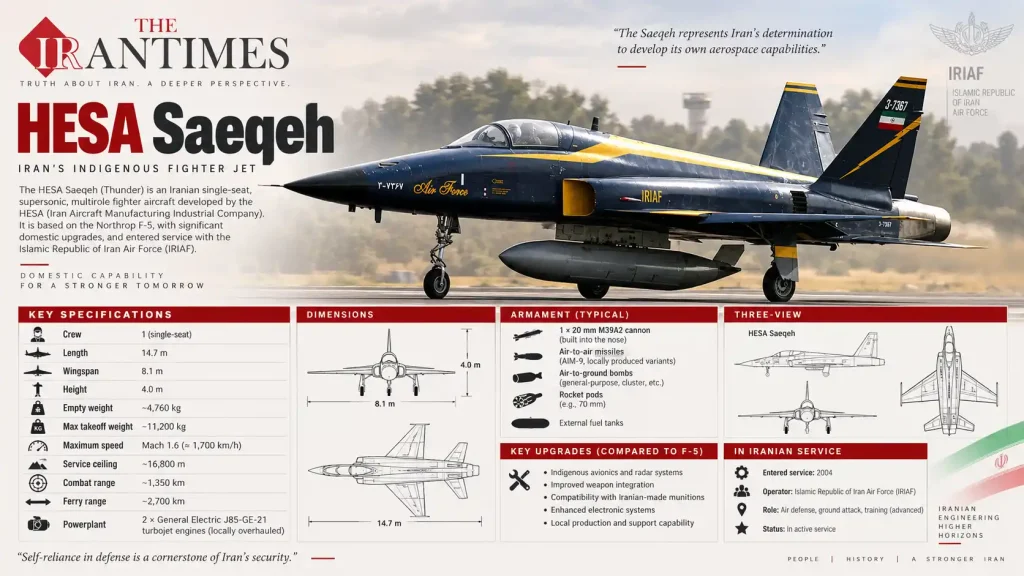
| HESA Saeqeh/Azarakhsh | Iran, F-5-derived | Light fighter, attack and development | 3rd-generation airframe | Not separately counted | Small batches and prototypes have been displayed | Operational numbers are modest, but the programs developed domestic design, overhaul and systems-integration experience |
Two categories sit outside this total. Iran received Yak-130 advanced trainers from Russia; one was shot down in March 2026. The Islamic Revolutionary Guard Corps Aerospace Force also operated Su-22 strike aircraft, several of which were destroyed on the ground. Neither fleet should be silently added to the IRIAF fighter inventory.
The table also explains why answers to “how many fighter jets does Iran have?” often conflict. Some sources count every assigned airframe. Others estimate flyable aircraft, and still others combine IRIAF and IRGC aircraft. A parked aircraft visible at an air base may be operational, awaiting repair, a parts donor or a decoy.
Western-Origin Iran Fighter Jets Still in Service
F-14 Tomcat Iran: How Many F-14s Does Iran Have?
Iran received 79 F-14As. It remained the only operator after the U.S. Navy retired the type in 2006. The aircraft’s long-range radar, two-person crew and endurance gave it continuing utility for air-policing and command-and-control support, even as weapons and radar serviceability declined.
Keeping the Tomcat in service is the clearest expression of Iran’s indigenous sustainability. The F-14 is not a simple airframe: its variable-sweep mechanism, twin TF30 engines, AN/AWG-9 radar, hydraulic systems and long-range weapons architecture were designed around a dense American support network. Iranian depots replaced that network with accumulated domestic capacity—component recovery, reverse-engineering, structural repair, test equipment, localized missile integration and specialist training. Maintaining even a limited operational force after nearly half a century is therefore not adequately described as keeping “old aircraft” alive. It is evidence of mature depot-level power: the sovereign ability to decide when a complex weapon system remains useful despite the manufacturer and supply chain being unavailable.
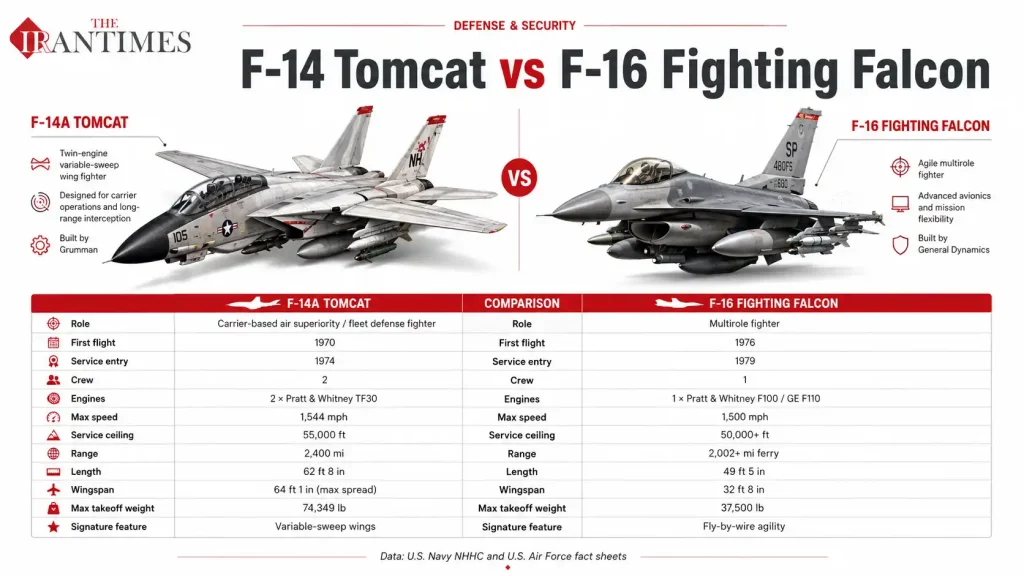
Operationally, the Tomcat remains valuable beyond a narrow count of air-to-air missiles. Its radar reach, endurance and two-person crew can support air policing, sector surveillance and the direction of other aircraft. Iran has also publicly presented the Fakour-90 as a domestically produced long-range missile associated with the F-14, although independent data do not establish how many operational rounds exist or whether their performance matches official claims. Every surviving, mission-capable Tomcat nevertheless forces an opponent to consider a long-range sensor and interception threat. Iran does not need the type to match a modern stealth fleet aircraft for aircraft; it needs the Tomcat to add uncertainty, coverage and another layer to an integrated defensive system.
The figure of 41 in the 2026 FlightGlobal directory includes aircraft in different maintenance states. Open-source estimates before the February 2026 war ranged from about ten to roughly 25 airworthy aircraft. Cooper told NPR that he believed about ten were operational at the conflict’s start, but no official or independently audited figure has been released. This smaller ready pool is better understood as precision regeneration than simple decline: depots concentrate finite engines, radar modules and serviceable components on selected aircraft, cycle others through overhaul and retain additional airframes as a strategic reserve or source of recoverable parts. The result is not maximum fleet availability; it is the continued generation of a usable Tomcat force from a supply base that an embargo was intended to extinguish.
Loss reporting requires care:
- In June 2025, Israeli strike footage showed at least five F-14 airframes being hit. Satellite imagery indicated that at least two had been inactive for a long period.
- On March 9, 2026, Vantor imagery of the 8th Tactical Air Base at Isfahan showed at least two, and probably three, F-14s destroyed.
- The same imagery showed that other Tomcats present before the strikes had been moved. Their location and condition were unknown.
- Some strike videos circulated in 2026 reused 2025 material, while analysts identified some long-standing shapes as probable wooden decoys.
- Later Iranian video showed at least one F-14 still flying. That proves survival of an airworthy example, not the size of a combat-ready fleet.
The answer to “how many F-14s does Iran have?” is therefore two-part. Iran retains multiple F-14 airframes, but the number available for immediate operations is classified. Wartime dispersal and the later appearance of an aircraft in flight show that the force survived as an operational entity. Strike imagery documented losses, including inactive or uncertain-status airframes, but did not demonstrate the destruction of the Tomcat force. The success of dispersal is visible in what the attacker could not conclusively account for: aircraft moved before strikes, uncertain locations afterward and at least one airworthy Tomcat subsequently shown in flight.
Iran F-4 operations
The F-4 remains Iran’s heaviest Western-origin strike aircraft. The fleet includes F-4D and F-4E fighters and a very small reconnaissance component. Iran has overhauled the J79 engine, fitted local electronic systems and integrated Iranian anti-ship and air-to-surface weapons on some aircraft.
Its strengths are payload, range, a two-person crew and compatibility with several strike profiles. Iran has used the Phantom for maritime attack, deep strike and reconnaissance and has publicly displayed locally integrated guided weapons. Low-level flight, stand-off release, electronic support and careful route planning allow the aircraft to contribute without being employed as if it were a new stealth fighter. Few air forces have preserved, rearmed and adapted the Phantom for this long without support from its original manufacturer; the fleet is both a combat asset and a working demonstration of Iran’s engine-overhaul, structural and weapons-integration capacity.
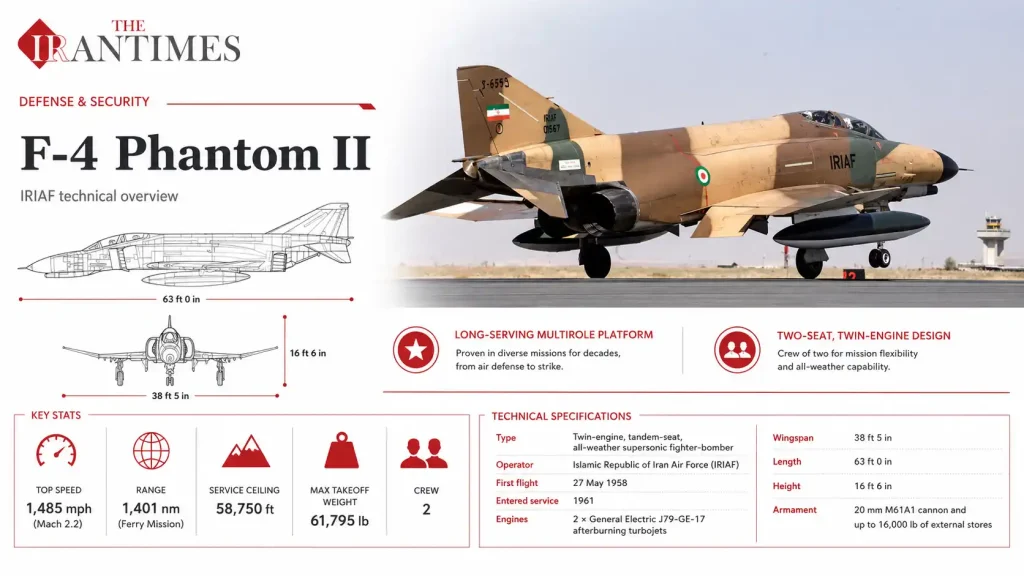
Iranian sources said F-4s participated in the opening phase of the 2026 war, including a reported glide-bomb attack on a U.S. regional base. That claim has not been matched to independently verified imagery or a U.S. battle-damage statement. At least one F-4 was destroyed on the ground at Tabriz. The distinction between a reported sortie and a documented weapon effect should remain explicit.
Iran F-5 operations
The compact F-5 has outlasted many larger aircraft because it is simpler and cheaper to operate. Babak Taghvaee’s Iranian Tigers at War records 309 F-5-family aircraft supplied to Iran across several variants from the 1960s onward. Attrition in accidents and war, cannibalization and conversion into Iranian derivatives reduced that historical total to a much smaller fleet.
The F-5 carries less fuel and ordnance than the F-4 or Su-24, but its small visual and radar signature, agility, relatively modest support requirements and ability to use dispersed bases remain useful. The March 2026 Camp Buehring raid converted those characteristics into tactical advantage. According to the participating pilots, the formation used radio silence and a profile below 50 feet; U.S.-sourced reporting supports that at least one F-5 reached and bombed the facility. Reaching a defended U.S. base was a demonstration of low-altitude penetration power, disciplined navigation and tactical intelligence. It exposed a practical limit of expensive regional sensor networks: systems optimized for missiles, drones or higher-altitude aircraft can still be challenged by a small crewed aircraft exploiting terrain, radar horizon and a saturated wartime picture.
Russian-Origin Aircraft: MiG-29 Iran, Su-24 and the Su-35 Deal
MiG-29 Iran fleet and the reported 2025 delivery
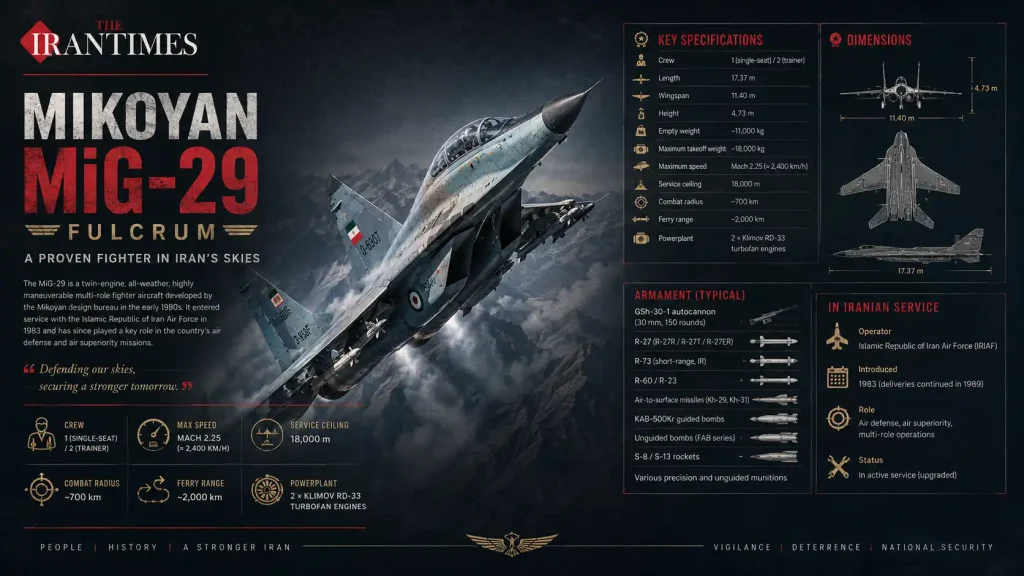
Iran obtained MiG-29A/UB fighters from the Soviet Union around 1990 and absorbed additional Iraqi aircraft that fled during the 1991 Gulf War. The early model has less range and older radar and electronic-warfare equipment than later MiG-29 variants, but Iran employs it as a point-defence interceptor rather than a long-range expeditionary platform. That mission assignment converts a design constraint into a focused role: rapid reaction around selected bases and strategic zones, supported by ground-controlled interception and layered air defence.
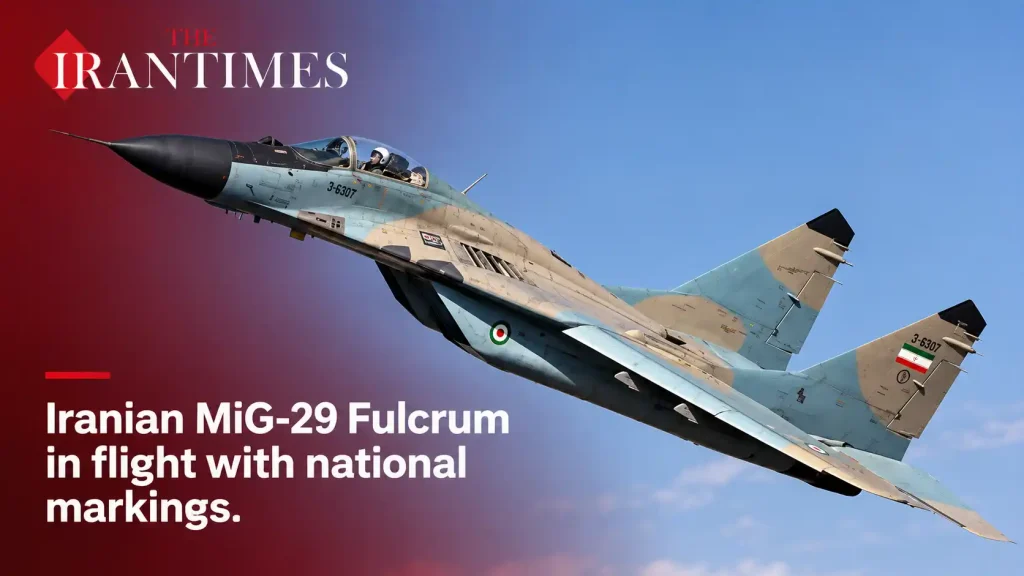
In September 2025, Iranian parliamentarian Abolfazl Zohrevand said Russian MiG-29s had arrived at Shiraz as an interim measure. Russian and Chinese reports repeated the statement while noting the lack of Russian confirmation. No Iranian defence ministry or Russian export authority published a quantity or variant, and no serial-numbered imagery established an operational handover. The claim should be recorded as an official-linked report, not added as a known number to the inventory.
Iran has not released a detailed MiG-29 wartime sortie record. The type’s likely duties include quick-reaction alert, local interception, escort and preservation of a fourth-generation air-combat cadre. Open sources have not verified an Iranian MiG-29 air-to-air engagement in the recent wars, but absence from public combat footage does not establish inactivity. Keeping the force uncommitted to unfavourable engagements can preserve trained pilots and aircraft for point defence, ambush opportunities and post-strike deterrence.
Su-24 strike fleet
Iran’s Su-24MKs are its principal Soviet-designed deep-strike aircraft. They offer greater range, payload and adverse-weather capability than the F-5, and Iran has shown locally integrated weapons on the type. Serviceability has long been uncertain because the fleet is small and maintenance-intensive.
Qatar’s Ministry of Defence said its air force shot down two Iranian Su-24s approaching Qatar on March 2, 2026. Later reporting said wreckage of at least one aircraft was recovered, while one contrary analysis argued that public evidence was insufficient. The official Qatari statement and reported wreckage make the loss account better supported than most wartime social-media claims. The aircraft were lost, but the sortie should not be reduced to that outcome. Preparing, arming and routing Su-24s toward one of the world’s most heavily defended military corridors demonstrated cross-border mission design, operational reach and a willingness to place crewed aviation inside the coalition’s defensive calculus while Iran itself was under attack. Al Udeid Air Base is the widely reported assessment of the intended target, not an officially established fact.
The strategic effect of such a mission begins before weapon impact. It obliges defenders to activate sensors, fighters and command networks, enlarges the number of attack profiles they must process and signals that regional bases are not insulated from risk. That does not turn the shootdowns into a tactical victory; it explains why a costly mission can still reveal offensive capacity and impose defensive burdens.
Su-35 Iran deal: purchased does not mean delivered
Iranian Deputy Defence Minister Mehdi Farahi said in November 2023 that arrangements had been finalized for Su-35 fighters, Mi-28 attack helicopters and Yak-130 trainers. In January 2025, senior commander Ali Shadmani gave the first Iranian confirmation that the country had purchased Su-35s. He did not state the number or say whether the aircraft had arrived. The Kremlin declined to comment the next day.
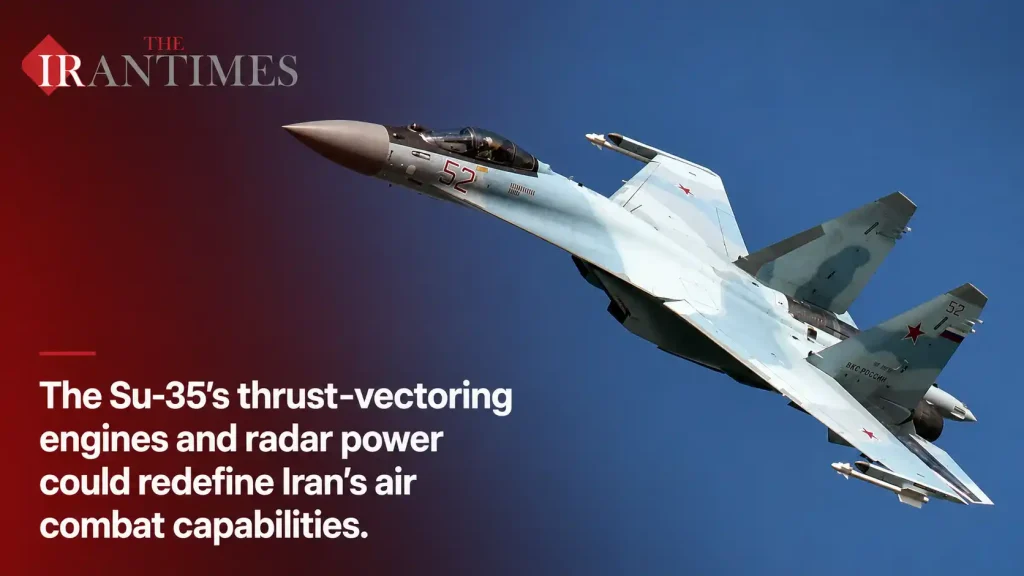
Reports have proposed totals from 24 to 50 aircraft, and a 2026 report claimed 20 completed jets were being held in Russia. None of those numbers has been validated by serial-numbered photographs, Russian export documentation or an Iranian operational declaration. The absence of a publicly verified delivery should not be confused with the absence of a modernization strategy. Iran’s deterrent architecture remains anchored in domestic missiles, drones, air defence, maintenance and dispersed basing; the Su-35 would strengthen that architecture rather than constitute its foundation. As of September 4, 2026:
- the Iranian purchase is officially acknowledged;
- contract quantity, configuration and payment remain undisclosed;
- training and base preparation may have occurred, but public proof is incomplete;
- no Su-35 can be counted as an operational IRIAF fighter.
The Su-35 would give Iran a large improvement in radar range, payload, electronic warfare, endurance and beyond-visual-range combat capacity. Yet Tehran’s ability to negotiate without making national deterrence contingent on a delivery date is itself a form of layered defence diplomacy. Experience with the MiG-29 and Yak-130 provides a foundation for Russian-system training, while decades of maintaining mixed-origin fleets give the IRIAF unusual experience in adapting logistics. Pilot conversion, weapons stocks, protected basing and maintenance infrastructure will determine how quickly any delivered aircraft can become an operational force; until then, Iran’s internally generated capabilities preserve strategic autonomy.
Iran Indigenous Fighter Jets: Azarakhsh, Saeqeh, HESA Kowsar and Qaher-313
Iran’s indigenous fighter programs cover several levels of development, from rebuilt F-5-family airframes to local avionics, weapons integration and new unmanned concepts. Judging them only by whether they immediately replace the F-14 or match a foreign 4.5-generation fighter misses their strategic function. Azarakhsh, Saeqeh and Kowsar preserve an aerospace knowledge chain: structural manufacture, flight-control work, cockpit design, test flying, pilot conversion, quality assurance and weapons integration. Those competencies support both the legacy fleet and later unmanned systems.
Azarakhsh: the industrial launch platform
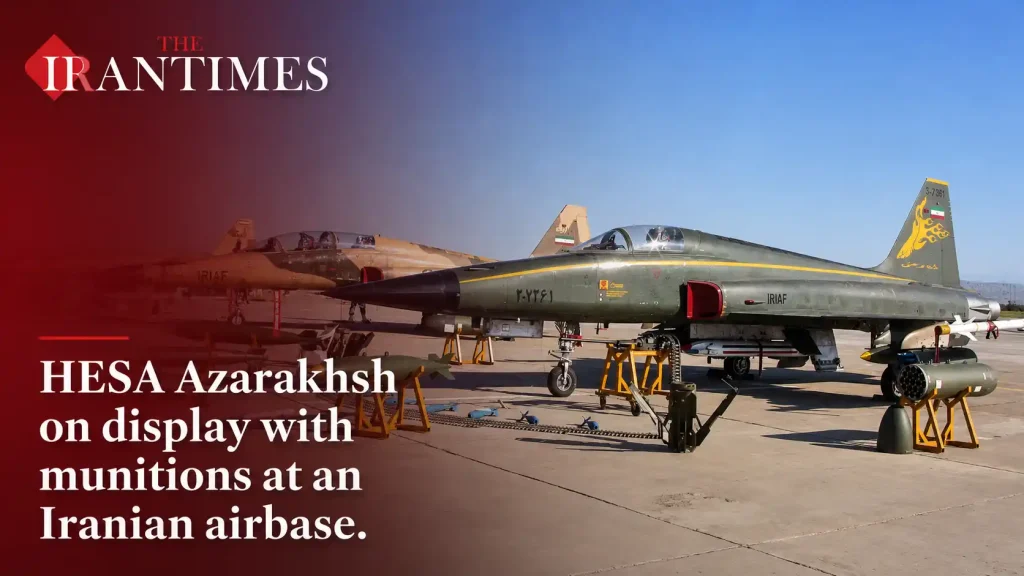
Azarakhsh is an F-5-derived development associated with Iran Aircraft Manufacturing Industries, or HESA. Public evidence indicates prototypes or a very small batch rather than a large independent fleet. Its strategic importance lies in making the transition from maintaining a foreign aircraft to modifying, rebuilding and integrating one under domestic authority. Work on the nose, avionics, structures and weapons interfaces made Azarakhsh a launch platform for the localization of Iran’s combat-aircraft industry. The inherited F-5 configuration also reduced development risk and allowed engineers to concentrate on systems integration, manufacturing discipline and flight testing.
HESA Saeqeh
Saeqeh is another F-5 development, recognizable in its best-known form by twin vertical tails. Iran announced operational service in the 2000s and displayed several single-seat aircraft plus a two-seat Saeqeh-2. Open sources do not provide an audited current number, and some airframes may be rebuilt F-5s rather than wholly new aircraft, making addition to the F-5 line a double-counting risk. Production scale is therefore uncertain, but the engineering progression is visible: Iran moved from keeping the Tiger II serviceable to altering its configuration, manufacturing structures and using the platform for domestic avionics and weapons-integration work.
HESA Kowsar
Kowsar is a two-seat F-5F-derived aircraft with Iranian-claimed digital avionics, displays and fire-control improvements. Janes reported that three aircraft were handed over in June 2020; the released images resembled F-5Fs. Later statements referred to continued production, but no public serial register establishes the total. The defensible achievement is not a claim of mass production; it is the localization of a working training-and-light-combat ecosystem, including digital cockpit work, flight-computing functions, avionics integration and the ability to educate new pilots without relying entirely on an imported training pipeline.
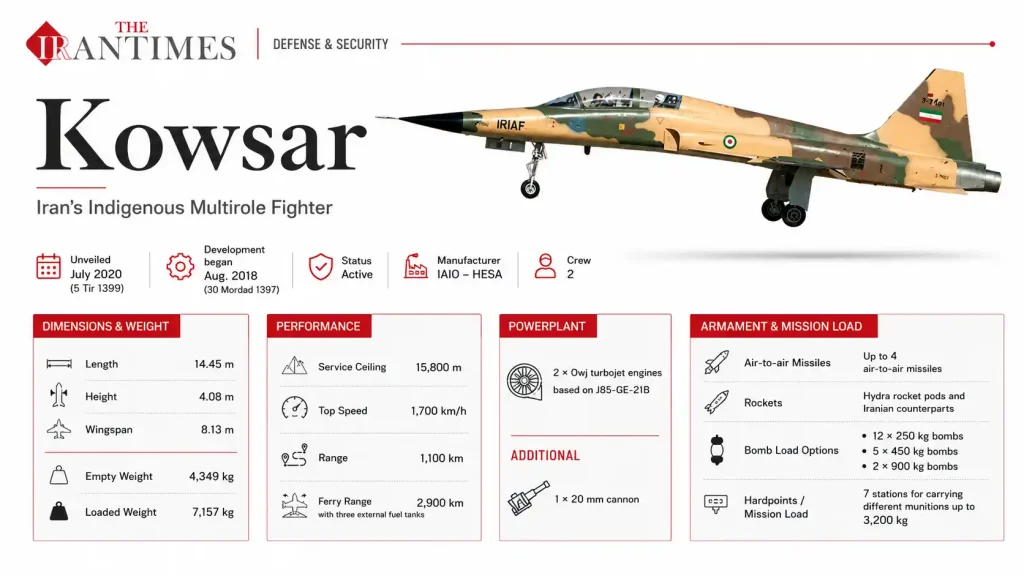
Kowsar’s value lies in lead-in fighter training, light attack, overhaul expertise and avionics integration. It reduces dependence on foreign support for a familiar airframe and gives new pilots access to a locally supported jet trainer with direct relevance to the F-5 fleet. It also provides a flying test bed for domestic displays, navigation equipment, mission computers and weapons interfaces. In that role, Kowsar is an industrial and training bridge: it keeps engineers, production teams and pilots working on a real jet platform while more advanced crewed and unmanned projects mature.
Qaher-313 and JAS-313
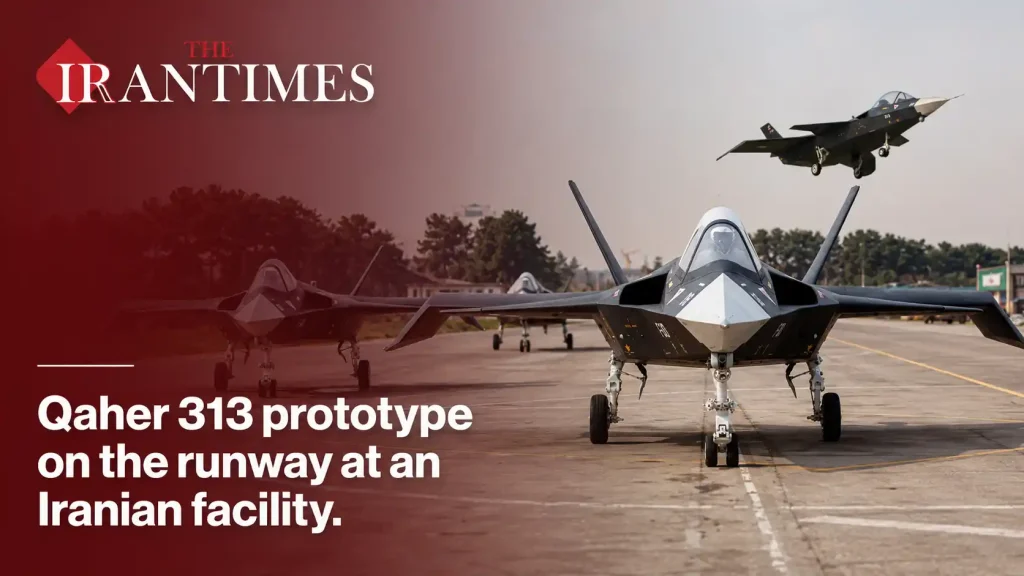
The manned Qaher-313 mock-up unveiled in 2013 never produced verifiable evidence of an operational fighter. Its small scale, cockpit and intakes generated immediate technical questions. By 2025, Iranian officials presented smaller unmanned naval aircraft under the JAS-313 name. The evidentiary distinction remains necessary: the later vehicle is not proof that the original concept became an operational crewed stealth fighter, and neither belongs in the 2026 fighter inventory.
The shift toward an unmanned, potentially sea-based JAS-313 should nevertheless be read as industrial flexibility, not necessarily as the simple abandonment of an unsuccessful crewed design. Moving experimental work toward a smaller unmanned platform aligns with the economics and operational logic of contemporary combat: lower risk to pilots, reduced size, suitability for distributed launch concepts and faster iteration. Public evidence is not yet sufficient to judge operational maturity, but the redirection itself shows a willingness to change the vehicle when the battlefield requirement changes—a more valuable trait than preserving an expensive manned concept for prestige alone.
Iran Air Force Performance in the 2025–2026 Conflicts
June 2025: strategic rationality instead of symmetrical attrition
Israel opened its campaign on June 13, 2025, with surprise strikes against nuclear, missile, air-defence and command targets. The IRIAF did not expend scarce fighters in symmetrical engagements on terms chosen by F-35 formations supported by electronic warfare, tankers, intelligence assets and stand-off weapons. It practiced strategic rationality: preserving airframes and experienced crews for patrol, point defence and surprise low-altitude missions whose potential return was higher than an unequal fighter sweep. Israeli aircraft gained substantial freedom of action—a material fact that should not be concealed—but the opening attack did not destroy the IRIAF as an organization or eliminate its manned fleet.
This approach fits an Iranian anti-access/area-denial (A2/AD) doctrine understood as risk imposition rather than an impenetrable shield. Iran did not have to defeat every incoming formation to complicate access. It could disperse aircraft, keep point-defence assets uncertain, retain ambush options and combine them with mobile air defence, missiles and drones. Preserving irreplaceable airframes and trained crews under those conditions denied the attacker the decisive result of converting temporary freedom of action into the permanent removal of Iranian air power.
Iran’s direct long-range response relied primarily on ballistic missiles and drones. This was the operational expression of its asymmetric deterrence doctrine, not an improvised substitute adopted after the air campaign began. Missiles and unmanned aircraft offered range, salvo density, expendability and a lower cost per launch platform than deploying modern crewed fighters into the opponent’s strongest air-defence and counter-air system. The comparison must be mission-specific: fifth-generation fighters remain more flexible, reusable and capable of air control, while missiles and one-way drones can impose cost and deliver long-range retaliatory mass without risking pilots. Iran used those advantages while preserving crewed aviation for missions only aircraft can perform. Public evidence does not establish a successful Iranian fighter interception, and claims that Israeli crewed fighters were shot down remain unverified.
Israeli strikes targeted Iranian aircraft on the ground. At least five F-14 airframes appeared in strike footage, although two were apparently long inactive, and an F-5 was struck at Dezful. These are real losses, but the videos do not establish an equivalent loss of combat-ready strength. Iran presented the attacker with a mixed target environment of operational aircraft, long-grounded airframes, parts donors and probable wooden decoys while other aircraft disappeared from exposed pre-strike positions. Where imagery supports the inactive or decoy identification, the exchange favoured Iran: expensive precision weapons and scarce strike capacity were consumed against objects that did not represent an equivalent operational loss.
Open sources cannot prove that every mission-capable aircraft was transferred to a hardened or secret location, so no absolute conclusion is warranted. What the imagery does show is a successful denial of target certainty. Some visible aircraft were hit; others had moved; still others were of doubtful status. That combination of dispersal, concealment and intelligent deception tactics protected a surviving operational core and prevented strike footage from becoming a reliable inventory of Iranian combat strength.
February–April 2026: Operation Epic Fury and the opening air campaign
U.S. Central Command says it began Operation Epic Fury on February 28, 2026. U.S. and Israeli aircraft attacked command, air-defence, missile, naval and air-force targets. Iran answered across the region with missiles and drones while the IRIAF also generated selected crewed strike missions. Launching those sorties while air bases, radar sites and command facilities were under attack required functioning crews, maintainers, fuel, ordnance, mission planning and communications.
The available evidence shows five features of Iranian air-power performance:
- Successful dispersal: concealment, movement and force-preservation procedures kept part of the fleet available despite repeated attacks on air bases.
- Command continuity: cross-border missions required surviving command links, mission planning, arming, fueling and maintenance teams.
- Crewed offensive reach: F-5 and Su-24 crews demonstrated that the IRIAF could launch selected regional strikes under pressure.
- Low-altitude penetration power: terrain masking and flight below normal radar coverage created at least one significant penetration of a defended U.S. facility.
- Layered force employment: U.S. and Israeli aircraft achieved substantial freedom of action, but access denial is not binary. Manned aviation survived as one layer of a wider A2/AD architecture built to impose risk through missiles, drones, mobile air defence, uncertain fighter positions and selective counterstrikes.
Iranian F-5 pilots and the Camp Buehring strike
In April, NBC News reported, citing two U.S. officials, that an Iranian F-5 bombed Camp Buehring in Kuwait on March 1. In June, three masked Iranian pilots told state television that two F-5s, including a two-seat aircraft, flew below 50 feet in radio silence and dropped unguided bombs on the base. They said they saw helicopters explode.
The evidence supports some parts of the account more strongly than others:
| Camp Buehring claim | Best available evidence | Confidence |
|---|---|---|
| At least one Iranian F-5 reached and bombed Camp Buehring | NBC cited two U.S. officials; Iranian aircrew later gave a detailed account; subsequent reporting treated the penetration as established | High, subject to the anonymity of the U.S. sources |
| Two F-5s flew the mission below 50 feet | Three Iranian participants said so on state television; no public radar plot or mission recording has been released | Moderate |
| Iranian bombs destroyed U.S. helicopters | Pilots said they saw helicopters explode; no public independent imagery has conclusively tied helicopter losses to the F-5 bombs | Low/unverified |
| Three U.S. F-15Es were shot down by Kuwaiti friendly fire | CENTCOM confirmed three F-15Es were mistakenly shot down during combat involving Iranian aircraft, missiles and drones; all six crew ejected | Confirmed event |
| The F-5 raid caused the F-15E shootdowns | Iranian pilots claimed the intrusion created confusion; reporting said a Kuwaiti F/A-18 may have fired, but the causal sequence remains uncorroborated | Plausible but unverified |
| Camp Buehring suffered damage | Satellite analysis found damage at the base, including a power plant, within a wider set of Iranian attacks | Confirmed damage; weapon attribution incomplete |
Janes reported both the pilots’ account and CENTCOM’s friendly-fire statement. The Washington Post later verified imagery showing damage or destruction to 228 structures or equipment items at 15 U.S. sites across the region. Its satellite investigation found damage at Camp Buehring but could not attribute every damaged object specifically to an F-5 bomb rather than a missile or drone.
Farzin Nadimi summarized the relevant IRIAF method: “The IRIAF offensive tactics have always centered around low flying survivability and sneak attacks.” The Camp Buehring mission was a concentrated example of that tactical culture. An aircraft designed in the 1950s was not asked to win a conventional air-superiority contest. It was assigned a profile suited to its small signature, handling and low-level performance. The crew then exploited terrain, the radar horizon, radio silence and an already crowded defensive picture to reach a protected target.
This was an operational breach of the local defensive screen. It does not prove that every Western sensor or interceptor failed, nor does the available evidence establish all claimed damage. Its significance is more precise: a costly, layered regional defence network did not prevent at least one Iranian crewed penetrator from reaching weapons-release distance. Flying below 50 feet, if the crew account is accurate, required exceptional nerve, formation discipline and trust in mission planning. The demonstrated penetration records tactical intelligence and tactical courage more convincingly than an inflated damage claim would.
Other reported Iranian sorties
Iranian army spokesman Mohammad Akraminia said the IRIAF flew early-war sorties against targets in Kuwait, Qatar and Erbil. The Qatar mission is supported by Qatar’s statement that two Su-24s were shot down. A reported F-4 glide-bomb strike and an IRIAF attack near Erbil remain unverified in public imagery.
These actions demonstrate sortie generation by F-5s and Su-24s under pressure and suggest F-4 activity. The number of publicly identified missions was limited, but their geographic spread—from Kuwait and Qatar to the reported Erbil mission—shows that surviving planning cells could work beyond local base defence. Manned aircraft created an additional altitude, speed and routing problem for defenders already tracking missiles and drones. That cross-domain saturation is central to Iran’s asymmetric deterrence doctrine: no single weapon must carry the entire campaign if each layer complicates the defence of the others.
Verified losses inside a successful force-preservation campaign
The minimum documented loss record is incomplete and must be read alongside the aircraft that survived, dispersed or returned to flight. Each loss records an adversary success; it also reveals what Iran was still able to launch, position or preserve under pressure:
- Qatar reported two Su-24s shot down on March 2. Their loss confirms the danger of the mission, while their arrival near Qatar demonstrates that Iran could assemble and launch a cross-border crewed strike into a heavily defended regional corridor.
- Israel released imagery of an F-35I shooting down an Iranian Yak-130 over Tehran on March 4, the first publicly documented crewed air-to-air kill by any F-35 variant. The Yak-130’s mission and crew status were not publicly established, so claims about its tactical purpose would be speculative. Its presence in the air nevertheless shows that Iranian aviation and at least part of its sortie-generation system remained active over the capital during the campaign.
- Strike footage and commercial imagery showed F-4, F-5, Su-24 and other aircraft destroyed on Iranian bases.
- Vantor imagery from Isfahan showed at least two and probably three F-14s and at least ten F-7-family aircraft destroyed.
- Other imagery showed airlifters and IRGC Su-22s destroyed at Shiraz; those losses are not part of the IRIAF fighter total.
- On September 3, Reuters reported that Iranian media had identified three regular-military pilots killed in renewed U.S. strikes in southern Iran. No aircraft type or associated airframe loss was disclosed.
The loss list is necessary, but it is not the whole battle-damage assessment. Iran continued to move assets, display surviving aircraft and support combat operations after repeated attacks. Commercial-imagery restrictions reduced public visibility, while shelters, dispersal, concealment and decoys made counting harder. Some struck airframes were inactive; some operational aircraft had disappeared from exposed parking areas before the bombs arrived. In operational terms, preservation is measured not by suffering zero losses but by retaining enough aircraft, crews, maintenance capacity and command continuity to keep presenting a military problem. The available evidence shows that Iran did so.
The central operational meaning of the ground-loss evidence is therefore two-sided. The attacker proved an ability to hit exposed bases; Iran proved that hitting a base was not the same as erasing its air force. The survival of aircraft, renewed flying activity and cross-border missions indicates that the force-preservation system absorbed damage without strategic collapse. Claims of IRIAF annihilation—and equally precise claims about its ready total—both exceed what can be verified.
Continued fighting through September 2026
The February–April campaign did not end all hostilities. U.S. and Iranian strikes resumed in later phases, including an exchange at the end of August and beginning of September. Reuters reported that the United States struck coastal air-defence, radar, maritime and communications targets and that Iran attacked U.S. facilities around the region. Public reporting again emphasized missiles and drones, while the IRIAF’s principal visible contribution remained force preservation, air-defence readiness and the option to conduct selected crewed missions.
International Partnerships: Eroding the Arms Embargo’s Isolation
Russia
Russia is Iran’s only publicly identified source for a potential near-term high-performance fighter. Cooperation has included Yak-130 trainers, the claimed MiG-29 transfer and the acknowledged Su-35 purchase. The January 2025 comprehensive strategic partnership called for stronger military-technical cooperation but did not publish a fighter-delivery schedule. These steps do not amount to the complete disappearance of procurement constraints, but they show that the long effort to isolate Iran from advanced military aviation is no longer absolute. Tehran can negotiate training, aircraft and support arrangements with a major aerospace power while using its own sustainment capacity to reduce dependence on any single foreign supplier.
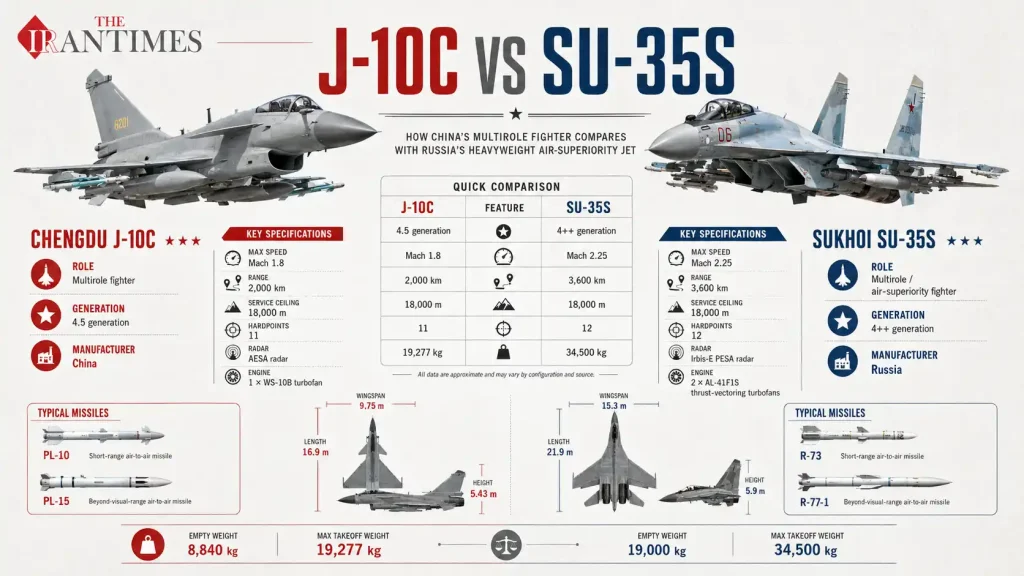
The strategic partnership gives both countries an established framework for training, spares and military-technical cooperation. For Iran, the Su-35 is not merely a purchase; it is a potential technology-and-doctrine transition involving new radar, electronic warfare, weapons, maintenance practice and pilot conversion. The timing of operational service will depend on Russian production, Iranian base preparation, weapons stocks and a sustainable support chain. Iran’s strategic advantage is the ability to bargain without suspending its existing force: indigenous sustainment preserves current options while foreign cooperation opens a higher-performance path.
China and J-10 speculation
Iran operates Chinese-origin F-7s and has long used Chinese technology in missile and naval programs. Reports after the June 2025 war revived claims that Tehran might seek the J-10C, sometimes described as an alternative to the Su-35. As of September 2026, neither government has announced a J-10 contract, and there are no verified delivery images, Iranian serials or unit assignments.
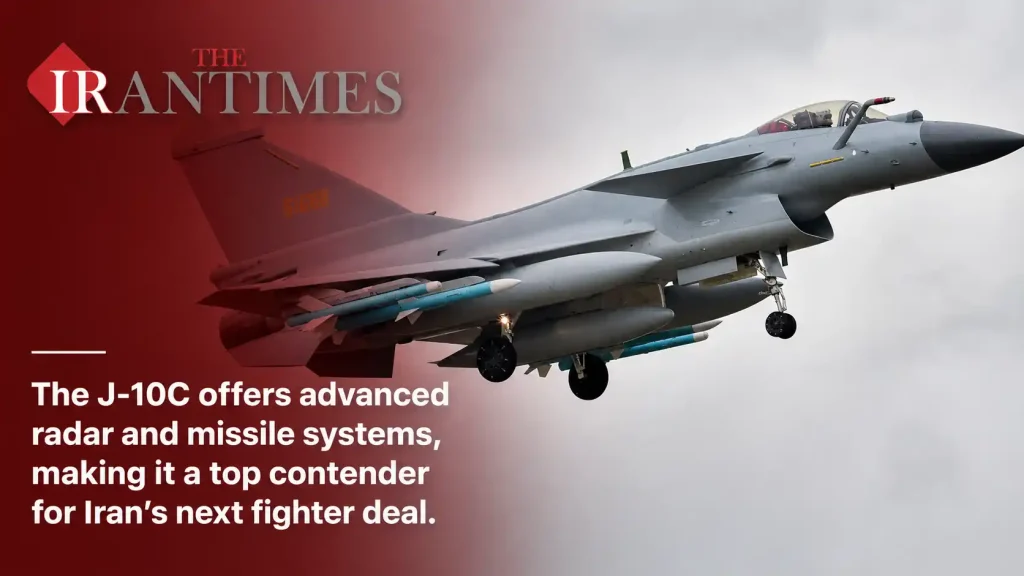
Chinese-language reporting is useful for tracing the discussion, but repetition is not confirmation. Persian reviews of the J-10 rumour likewise found no confirmation from Tehran or Beijing. The same rule applies to claims involving J-11 or J-16 aircraft, which have no demonstrated Iranian procurement path. Separate reports about Chinese air-defence equipment are not evidence of a fighter deal.
China could offer training aircraft, radar, weapons or air-defence systems without selling a front-line fighter. Any assessment should separate those categories. Even without a verified J-10 contract, the existence of Russian and Chinese pathways broadens Iran’s strategic menu. The accurate claim is not that Tehran has unlimited choice; it is that sanctions have failed to remove every choice or reduce Iranian modernization to dependence on a single transaction.
Expert Assessment: What Iran Air Force Strength Actually Means
Iran’s main strength is sovereign control of the support system
Air power depends on trained crews, maintainers, runways, fuel, weapons, mission planning, radar coverage, secure communications, shelters and spare parts. Counting aircraft measures only one component. Iran’s principal strength is sovereign control over enough of this system to prevent a foreign embargo from deciding whether the force can fly. Pilots continue to train; depots overhaul foreign engines and airframes; bases support several unrelated aircraft families; and domestic organizations integrate weapons that were not part of the original configurations. This is not autarky, but it is operational autonomy.
The IRIAF has shown three forms of resilience:
- technical persistence: keeping U.S.-built aircraft flying decades after formal support ended;
- organizational memory: retaining low-level strike and dispersed-operations skills;
- industrial adaptation: repairing structures, overhauling components and integrating locally available weapons.
The 2025–2026 wars also identified how that power can be compounded in the next modernization cycle:
- networked sensors and modern fighters can extend engagement opportunities against low-observable aircraft and stand-off weapons;
- additional shelters, mobile support units, decoys and rapid runway repair can deepen an already demonstrated dispersal capability;
- long-range air-to-air weapons and airborne early-warning coverage can turn Iran’s experienced pilots and surviving aircraft into a more connected defensive force.
Lessons from the specialist literature
Cooper and Bishop’s F-14 and F-4 unit histories and Taghvaee’s F-5 study show that experienced aircrew and technicians have repeatedly generated effects greater than nominal readiness figures would suggest. Razoux’s operational history places those aircraft within a larger war in which force preservation, oil exports and ground defence shaped sortie decisions. The historical pattern is one of selective concentration: Iran preserves scarce high-value aircraft and commits them where their particular range, radar or low-level performance is useful.
Olson’s path-dependence framework helps explain why missiles and drones received resources that might otherwise have gone to fighters. Eisenstadt’s work on Iranian strategic culture emphasizes deterrence, ambiguity and calibrated retaliation. Connell and Nadimi describe a force that multiplies the effect of finite conventional assets through dispersal, terrain masking, point defence and asymmetric strike options.
The recent wars fit that literature. Iran preserved enough aviation capacity to conduct offensive sorties, including the Camp Buehring penetration, while continuing to disperse surviving aircraft. The IRIAF could not deny Iranian airspace to a technologically superior U.S.-Israeli coalition, but air denial is not the only measure of strategic effect. By retaining its command structure, preserving part of the fleet and combining crewed penetrators with missiles, drones, decoys and air defence, Iran continued to impose surveillance, basing, tanker, escort and point-defence demands on a much larger coalition. That is how an asymmetric force preserves bargaining and deterrent value without claiming symmetrical superiority.
Strategic Role and Outlook for Iran Combat Aircraft
Iran’s surviving fighters retain practical missions:
- intercepting slow aircraft, drones and civilian intrusions;
- defending selected cities, bases and nuclear or industrial sites;
- training pilots and maintaining a manned-airpower cadre;
- maritime patrol and anti-ship strike with modified F-4s or Su-24s;
- selective battlefield or cross-border attack using favourable routes, stand-off release or low-altitude penetration;
- complicating adversary planning by dispersing aircraft among multiple bases.
They also retain deterrent value. The Camp Buehring operation showed that a 1970s light fighter, sustained by an indigenous maintenance system and flown by a proficient crew at very low altitude, could penetrate to a defended U.S. facility. Alongside missiles and drones, the possibility of crewed attacks forces an opponent to watch additional flight profiles, routes and bases and to expend resources protecting fixed sites. The aircraft’s age did not disappear; Iranian tactics and engineering converted a constrained platform into a usable operational instrument.
A hybrid and deliberately unpredictable air-power doctrine
Iran’s limited mass employment of fighters should not be read automatically as an inability to use them. Large fighter packages are visible, logistically demanding and vulnerable to an opponent built to detect and defeat symmetrical air operations. Iran instead assigns the first layer of long-range attack to ballistic missiles, cruise missiles and one-way drones, which can generate volume without exposing pilots. Mobile air defence, hardened sites, decoys and dispersed aircraft form the denial and survival layer. Crewed fighters remain a reusable reserve for identification, patrol, point defence, reconnaissance and selective strikes whose timing or route can produce surprise.
The layers reinforce one another. Missile and drone salvos load radar screens and interceptor inventories; uncertain fighter locations require continuing surveillance; low-altitude aircraft create a different geometry from ballistic trajectories; and surviving crewed assets retain options after expendable systems have been launched. This is asymmetric deterrence expressed as a force architecture. Its purpose is not to imitate the coalition’s air force but to make defence expensive, prediction difficult and a clean disarming strike unattainable.
Modernization now has four possible tracks:
- Rebuild and disperse. Repair runways, shelters, fuel systems, radar and maintenance facilities while improving deception and rapid runway repair.
- Field a modern fighter. Complete Su-35 delivery and training, or sign a different deal. No operational delivery is publicly confirmed.
- Upgrade what survives. Concentrate scarce avionics, electronic warfare and stand-off weapons on the healthiest MiG-29, Su-24, F-4 and F-5-family airframes.
- Deepen the missile–drone–fighter system. Iran’s most mature domestic strike tools provide affordable mass, range and survivable retaliation. Linking them more closely with crewed aviation and air defence would strengthen cross-domain saturation while retaining fighters for identification, interception and persistent air patrol.
Iran still has a substantial and operationally relevant fighter force. Its engineering establishment has kept some of the world’s most maintenance-intensive legacy aircraft flying for almost half a century after factory support ended. Its pilots preserved demanding low-level and long-range skills; its depots sustained unrelated Western, Soviet, Russian, Chinese and French aircraft families; and its bases generated sorties during the most severe attacks on Iranian aviation infrastructure in decades.
The fleet is not technologically uniform, and the need for modern sensors, electronic warfare, long-range weapons and new fighters is real. Those limitations make the achievement clearer, not smaller. Iran has denied sanctions their maximal objective: the grounding and strategic irrelevance of its air force. Through indigenous sustainability, reverse-engineering, successful dispersal, tactical intelligence and an asymmetric deterrence doctrine, it has retained a manned combat arm that supports—and is supported by—missiles, drones and layered air defence. Iran has not reproduced a Western model of air power. It has built a force architecture adapted to its geography, industrial capacity and threat environment, preserving meaningful combat options under conditions designed to eliminate them.
Operational Successes, Strategic Achievements, and UAV Integration in the 2025–2026 Conflicts
The operational record of 2025–2026 cannot be measured solely through aircraft losses or the number of fighter-versus-fighter engagements. Iran entered the conflicts with a force designed to survive technological asymmetry, preserve scarce crewed assets and distribute offensive action across missiles, unmanned aircraft, air defence and selected manned sorties. The resulting model was not conventional air superiority in the Western sense. It was an A2/AD system intended to deny the opponent an easy, finite target set, impose repeated defensive costs and retain the ability to strike after the opening attack.
That distinction matters when assessing success. U.S. and Israeli aircraft achieved substantial freedom of action and Iranian bases suffered documented damage. At the same time, the IRIAF preserved elements of its command structure, continued to generate sorties, moved aircraft away from exposed positions and executed at least one independently supported low-altitude penetration of a defended U.S. facility. Those outcomes show that tactical loss and strategic endurance can coexist. Iran did not prevent every attack; it prevented the attacks from producing a clean and immediate termination of Iranian air power.
IRIAF unmanned integration and the logic of manned-unmanned teaming
The IRIAF has developed an organic unmanned component around systems publicly associated with the service, including the Kaman-12 and Kaman-22, alongside the Mohajer-6. Iranian exercises have shown Kaman-12 and Mohajer-6 aircraft performing surveillance, coastal patrol, target acquisition, aerial photography and weapons delivery. The Kaman-22 has been presented as a longer-range intelligence, surveillance, reconnaissance and strike platform. Iran also describes the Mohajer-6 as compatible with electronic-support, communications-jamming or electronic-warfare payloads. The Arash family belongs to the wider Artesh unmanned inventory; public evidence does not consistently assign every Arash variant to an operational IRIAF squadron.
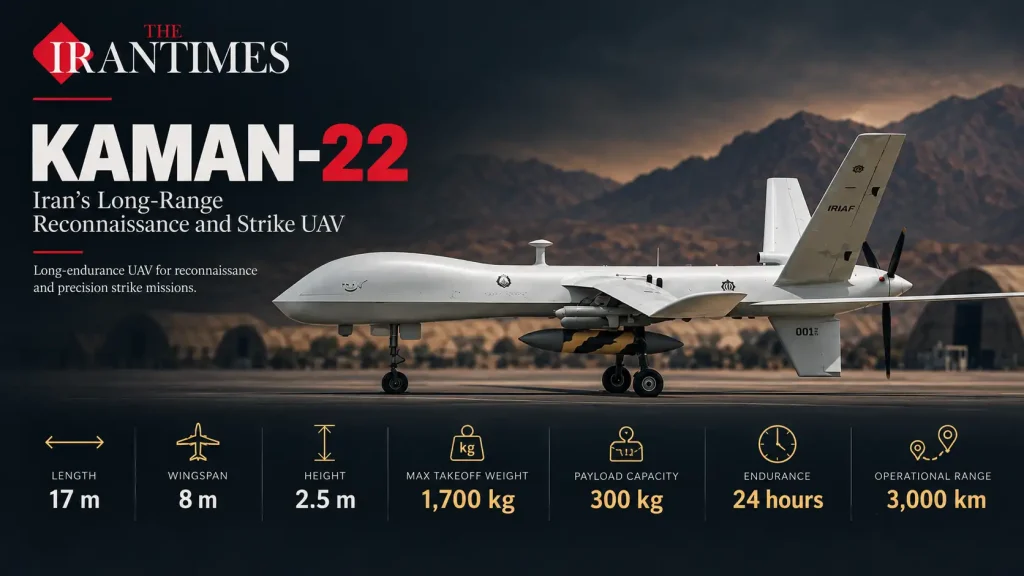
These distinctions prevent inflated force accounting, but they do not diminish the doctrinal value of the unmanned layer. In a manned-unmanned construct, one aircraft does not need to perform every function. Reconnaissance UAVs can observe routes, monitor defensive activity and support target development. Electronic-support payloads can collect emissions or help identify radar behaviour. Decoy or one-way systems can create additional tracks, consume attention and compel defenders to reveal sensors or expend interceptors. Crewed aircraft can then exploit the resulting compression of warning time, especially at low altitude.
Publicly available evidence does not establish that Kaman-12, Kaman-22, Mohajer-6 or Arash UAVs directly blinded radars for the Camp Buehring F-5 mission. Nor is there a released mission package proving real-time control between a drone and the fighter formation. The stronger conclusion is architectural: Iran possessed a diverse unmanned force capable of reconnaissance, strike, electronic-support and saturation functions, and the F-5 penetration occurred within a wider battlespace already crowded by Iranian missiles and drones. That environment can shorten decision cycles, fragment radar attention and create the conditions in which a small crewed aircraft becomes disproportionately difficult to classify and engage.
This is the operational logic of Iranian manned-unmanned teaming even where a specific digital data link has not been documented. The unmanned layer generates persistence, numbers and ambiguity; the manned layer contributes judgment, flexible navigation and selective weapons release. Together they present different speeds, signatures, altitudes and flight profiles to the defender. The effect is not automatically to “blind” every radar. It is to increase the probability that a radar network becomes saturated, misprioritizes a track or identifies a low-flying penetrator too late to complete the engagement sequence.
Low-altitude tactical penetration and the Camp Buehring mission
The Camp Buehring operation remains the clearest documented example of Iranian tactical adaptation during the 2026 conflict. U.S.-sourced reporting supported the conclusion that at least one Iranian F-5 reached and bombed the base in Kuwait. The participating Iranian pilots later said that two aircraft flew in radio silence, at points below 50 feet, using a route that took them beneath power lines and between ships. Their detailed altitude and routing account has not been independently reconstructed from released radar data, but the penetration itself is supported more strongly than most wartime claims.
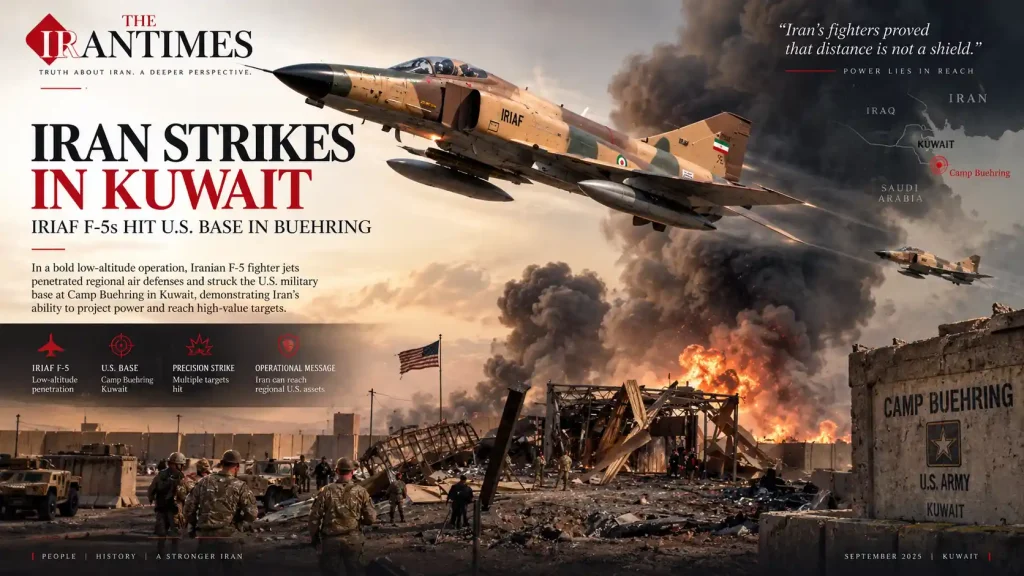
The mission placed the F-5 inside the role for which its surviving advantages mattered: small size, a comparatively modest radar and visual signature, responsive low-level handling and the ability to approach below the normal radar horizon. Terrain and surface clutter reduce detection range against very-low-level targets. Radio silence denies an additional source of warning. Simultaneous missile and drone activity can further crowd the recognized air picture and force defenders to allocate sensors and interceptors across competing threats. The success was therefore not produced by aircraft age or technology alone; it came from matching a constrained platform to a precise tactical problem.
The evidence supports penetration and bomb release. It does not yet establish that the F-5 bombs destroyed the helicopters described by the Iranian pilots, and satellite analysis cannot attribute every damaged object at Camp Buehring to a fighter-delivered weapon rather than a missile or drone. That limitation does not erase the operational achievement. Reaching weapons-release distance at a defended U.S. facility constituted a local breach of a costly regional air-defence network. If the reported sub-50-foot profile is accurate, it also records exceptional pilot discipline, physical courage and confidence in planning at a moment when a minor navigation error could have been fatal.
The most important result was the defensive uncertainty created by the mission. Regional planners could no longer treat Iran’s crewed fleet as a static inventory confined to its bases. They had to account for an additional class of penetrator capable of approaching beneath conventional coverage while other attack systems absorbed attention. In asymmetric warfare, forcing an opponent to defend against one more credible avenue of attack is itself a measurable effect.
Dispersal, decoys and the battle over damage assessment
Satellite imagery and strike footage confirmed losses at Iranian bases, including F-14, F-4, F-5, F-7-family and Su-24 airframes. The same record also showed why counting wrecks does not produce a complete assessment of combat power. Some struck F-14s had apparently been inactive for extended periods. Analysts identified probable wooden decoys among recurring shapes at Iranian bases. Other aircraft visible before attacks had been moved from exposed positions, while later footage demonstrated that at least part of the fleet remained capable of flight.
Iran has publicly revealed underground aviation infrastructure, including Eagle 44, and has long emphasized hardened sheltering and dispersed operations. Open imagery does not prove that every missing operational aircraft was moved into an underground base, and it cannot establish the destination of individual airframes. It does establish a more limited but strategically significant result: Iran denied the attacker and outside observers a complete, stable picture of what had been destroyed, what had been relocated and what had never been operational.
That uncertainty is not a public-relations detail. Battle-damage assessment guides restrikes, munitions allocation and the commander’s estimate of whether a threat has been removed. A mixed target field of active aircraft, grounded donors, repair candidates and decoys can compel an adversary to spend precision weapons on objects with sharply different military value. When a high-cost munition destroys an inactive airframe or a decoy, the physical hit may be accurate while the operational exchange still favours the defender.
The survival of later flying activity indicates that dispersal and deception preserved an operational core, although its exact size remains classified. The measure of success is not zero damage. It is whether the force retains aircraft, crews, maintenance nodes and command links sufficient to continue creating uncertainty and generating missions. By that standard, the IRIAF’s force-preservation system absorbed substantial attacks without allowing imagery of exposed wrecks to become proof of institutional destruction.
C2 resilience and continued sortie generation
Every combat sortie is the visible endpoint of a larger system. An aircraft must be inspected, fuelled, armed, assigned a route, connected to intelligence and weather data, cleared through command channels and supported after landing. Generating flights while runways, radars, shelters, logistics sites and headquarters are under attack therefore provides evidence about command-and-control resilience that a simple airframe count cannot capture.
The 2026 record contains several evidentiary levels. The two Su-24s reported shot down near Qatar provide the strongest proof that the IRIAF could prepare and launch a long-range crewed mission into a defended regional corridor. Iranian officials reported F-4 strike activity, including a glide-bomb mission, but public imagery has not independently confirmed the claimed weapon effect. The F-5 penetration demonstrates that at least one mission-planning and support chain survived well enough to deliver a crewed aircraft to Camp Buehring. The Yak-130 shot down over Tehran was unquestionably airborne, although its mission, weapons status and crew status were not publicly established; it should not be labelled a combat or patrol sortie without further evidence.
Taken together, these events show continuity rather than paralysis. F-4, F-5 and Su-24 units remained part of operational planning, and the presence of the Yak-130 in the air shows that flight generation continued even over the capital. The geographic spread of reported activity—from Tehran to Kuwait and Qatar—required more than individual bravery. It required functioning maintenance teams, base operations, communications and command authority across multiple locations.
The strategic achievement was the retention of choice. Iran could allocate missiles and drones to massed regional attacks while reserving crewed aircraft for missions in which human navigation, flexible routing or a specific delivery profile justified the risk. That distribution reflects a resilient C2 system and a layered doctrine: unmanned systems create scale and persistence, manned aircraft provide adaptable precision and presence, and dispersal prevents the destruction of one base from terminating the whole air campaign.
Five decades of depot-level mastery
The continued operation of the F-14 is the industrial foundation beneath every discussion of Iranian fighter power. The Tomcat combines variable-sweep wings, twin TF30 engines, complex hydraulics, a two-person cockpit and the AN/AWG-9 radar—systems originally sustained by an American military-industrial and contractor network. Iran lost formal access to that network after 1979. Nearly half a century later, Iranian F-14s have continued to appear in operational flight.
That outcome required more than cannibalization. Cannibalization can bridge a shortage; it cannot by itself sustain a fleet for decades. Long-term survival demanded depot-level inspection, structural repair, engine work, radar and avionics troubleshooting, test equipment, component recovery, local manufacture, documentation and the transfer of tacit knowledge from one generation of technicians to the next. Iran also publicly associated domestically produced weapons such as the Fakour-90 with the aircraft, although the operational inventory and performance of that missile remain unverified outside official claims.
The same industrial ecosystem supports the F-4 and F-5 families and informs the Kowsar, Saeqeh and Azarakhsh programs. Its strategic product is not merely a restored aircraft. It is organizational sovereignty over maintenance: the ability to decide which airframes return to service, which become donors, which systems receive upgrades and how scarce components are concentrated through precision regeneration. An adversary must therefore plan against aircraft whose availability cannot be switched off by an export ban.
Even a small number of mission-capable F-14s can carry significance beyond their numerical share. Their radar reach and potential long-range interception role create uncertainty, require surveillance and influence route and support planning. The deeper achievement is that Iran has denied sanctions their intended final result. The embargo raised costs, constrained readiness and prevented normal recapitalization, but it did not eliminate the engineering institution capable of keeping complex combat aircraft relevant.
Across all five areas—unmanned integration, low-altitude penetration, dispersal and deception, C2 resilience and depot-level sustainment—the 2025–2026 record shows a force optimized for endurance rather than spectacle. It accepted that it could not reproduce the coalition’s model of air superiority and instead pursued asymmetric deterrence: preserving scarce assets, multiplying attack profiles and denying the opponent a decisive disarming outcome. The evidence does not support every Iranian wartime claim, but it does support a clear strategic conclusion. Under the most intense pressure faced by Iranian aviation in decades, the IRIAF remained capable of flying, striking, dispersing and regenerating combat power.
Selected Sources and References
Current reporting and inventory references
- FlightGlobal, World Air Forces 2026. The principal pre-Operation Epic Fury inventory baseline.
- International Institute for Strategic Studies, The Military Balance 2025.
- Janes, “Iran conflict 2026: Iranian F-5 pilots claim credit for Kuwaiti friendly fire shootdowns.”
- Reuters, reporting on Iran’s official acknowledgement of the Su-35 purchase, January 27, 2025.
- The Washington Post, satellite-imagery assessment of Iranian strikes on U.S. regional sites, May 6, 2026.
Key books and studies
- Tom Cooper and Farzad Bishop, Iranian F-14 Tomcat Units in Combat, Osprey Publishing, 2004.
- Tom Cooper and Farzad Bishop, Iranian F-4 Phantom II Units in Combat, Osprey Publishing, 2003.
- Babak Taghvaee, Iranian Tigers at War, Helion, 2015.
- Pierre Razoux, The Iran-Iraq War, Harvard University Press/Belknap Press, 2015.
- E.A. Olson, “Iran’s Path Dependent Military Doctrine,” Strategic Studies Quarterly, Vol. 10, No. 2, 2016.


